By The Flooring Centre Technical Team
Quick Answer
Hybrid flooring can be installed on chipboard (yellow tongue) subfloors, but it is one of the most demanding environments hybrid is ever asked to perform in — and an upstairs chipboard floor with significant glazing is the single highest-risk install scenario for a PVC-based flooring product. The thermal expansion behaviour of hybrid is well understood by manufacturers and is provided for in their install standards (AS 1884 perimeter expansion, control joints across large runs, a 1mm builder's plastic separation layer between hybrid and chipboard). When those rules are followed and the homeowner manages temperature and solar gain after install, hybrid will perform.
When any of those conditions are missing — undersized perimeter gaps, no control joints, no separation layer, or an upstairs space that regularly exceeds the manufacturer's operating temperature window — hybrid will fail. The failure mode is consistent: the floor expands hard up against the wall, runs out of room to move, and peaks at the head joints (the short cross-joints between board ends). In the worst cases — typically on cheaper EVA-backed product — the built-in foam underlay softens, partially fuses to the chipboard below, and the floor loses the ability to slide independently of the subfloor. From that point, every seasonal cycle adds compression load that the joints have nowhere to release.
For most upstairs chipboard installations with large windows, water-resistant laminate is the technically superior product. Where hybrid is the right answer, this guide walks through how to install it so that it actually lasts.
What "chipboard" and "yellow tongue" actually mean
Chipboard is the engineered wood subfloor that sits on the floor joists in the vast majority of Australian two-storey homes built since the early 1990s. The dominant product in this category is sold under the brand name "Yellow Tongue" by Carter Holt Harvey — a structural particleboard panel with a tongue-and-groove edge profile that allows panels to be glued and screwed together to form a continuous structural floor diaphragm above the joists.
Yellow Tongue is excellent at what it was designed to do. It is structural, dimensionally stable for an engineered wood product, moisture-tolerant during the construction phase, and economical. What it is not designed to do — and this is the source of almost every hybrid-on-chipboard problem we see — is to manage the long-term thermal interface with a PVC-based flooring product laid directly on top.
The technical issue is that chipboard, despite being an engineered wood, still has the dimensional characteristics of a wood-based product. It expands and contracts with moisture content. Hybrid, by contrast, is a polymer product that expands and contracts with temperature. Two different materials, two different drivers of movement, behaving on slightly different schedules, sharing a single interface plane. Get it right and they cohabit perfectly. Get it wrong and they fight.
Why upstairs is harder than downstairs
Hybrid on a downstairs slab is forgiving. The concrete slab has enormous thermal mass, the floor temperature stays within a narrow band across the seasonal swing, and the moisture interface is a known engineering problem with a known solution (a moisture barrier, usually a builder's plastic underlay).
Hybrid on an upstairs chipboard subfloor is a different proposition. Three things change:
- The subfloor itself has very little thermal mass. The chipboard panel is around 22mm thick and is in direct thermal contact with the air below the joists (the ground-floor ceiling cavity) and the air above. It heats up and cools down with the room.
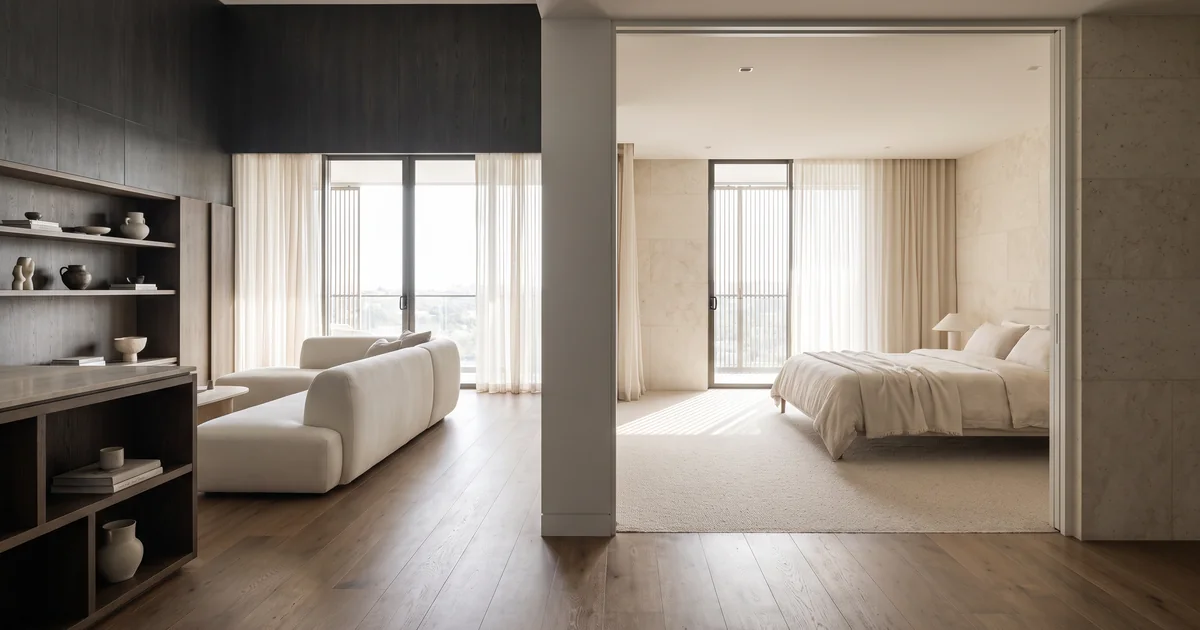
- The room above an upstairs chipboard floor is, in most contemporary Australian homes, glazed on at least one face. Modern open-plan upstairs living, master suites with floor-to-ceiling windows, and the "second living" upstairs configurations that have become standard in new builds all expose the floor to significant direct solar gain.
- The thermal stack effect means upstairs rooms run measurably hotter than downstairs rooms during summer. In Melbourne, the differential between a downstairs and upstairs ambient temperature on a hot day can be 8 to 12 degrees Celsius, with the upstairs floor surface temperature higher again because of direct solar absorption.
The combination of a low-thermal-mass subfloor, direct solar gain through glazing, and the natural stack effect produces a thermal environment that no other floor in the house experiences. PVC-based hybrid is a thermally reactive product. Asking it to live in this environment is asking the most of it.
What "thermally reactive" actually means in practice
Hybrid flooring is built around a rigid SPC (solid polymer core) or EPC (expanded polymer core) — both PVC compounds. PVC is a thermoplastic. It expands when heated and contracts when cooled, and unlike a wood-based product where the dimensional change is driven by moisture absorption (and is therefore slow and seasonally averaged), PVC's dimensional change is driven by temperature and is fast.
The typical linear coefficient of thermal expansion for SPC hybrid is in the order of 4-5 × 10⁻⁵ per degree Celsius. In plain language: a 6 metre long run of hybrid flooring, exposed to a 30-degree temperature swing across a Melbourne summer-to-winter cycle, will want to change in length by approximately 7-9mm.
Multiply that across a 125 m² continuous open-plan upstairs installation laid in one direction, and the cumulative movement is significant. The flooring system needs to be designed to absorb that movement without buckling, peaking, or pulling the click-locks apart at the joints. That is what the perimeter expansion gap, the control joints, and the manufacturer's install standards exist to provide for.
When any of those provisions is missing or undersized, the floor cannot move. The thermal energy doesn't go away — it expresses as compression load on the locked-up floor. Eventually something fails. Usually the click-lock at the weakest joint, and the floor visibly peaks or separates at the head joints between board ends.
The install standards that actually matter
For hybrid on chipboard upstairs, four install conditions are non-negotiable:
Perimeter expansion gaps sized to AS 1884
AS 1884 is the Australian Standard for the installation of resilient floor coverings. For hybrid, the perimeter expansion requirement is typically 10-12mm around the full perimeter of the floor and around every fixed object that penetrates the floor plane (kitchen cabinets, fireplaces, columns, door jambs, stair noses). The gap is covered by skirting, scotia, or expansion trim — it is invisible in the finished floor, but it is what allows the floor to breathe.
The most common install failure we see on inspection is a perimeter gap that has been undersized in one or two locations — typically at a kitchen island, a fireplace hearth, or a complex stair return — because the installer treated those as "tight" features rather than as fixed penetrations through the floor plane. The floor will fail at those points first.
Control joints sized to the manufacturer's raft size
Control joints are sized to limit the length of any single uninterrupted run of flooring, not just the total area. The technical term is "raft size" — the maximum unbroken expanse of floor any manufacturer will warrant. As a rule of thumb, most hybrid brands warrant a maximum raft size of around 10–12 metres in any one direction, and the specifics vary by brand, board format, and core type — always defer to the manufacturer's published install standard.
What that means in practice: a 100 m² floor can easily breach the raft limit even though the total area is well within tolerance. A long narrow corridor of 2m × 50m, for example, is only 100 m² but is over four times the warranted run length. It needs control joints. The same 100 m² laid as a 10m × 10m open-plan square sits inside the raft size and needs none. We size the joints to the geometry, not just the area.
A control joint is a deliberate engineered break in the floor that allows each side to move independently. It is concealed under a T-bar transition or under a fixed object such as a kitchen island, and it is what prevents the cumulative thermal movement of a large run from concentrating at the perimeter or peaking at the head joints between board ends. For the 125 m² upstairs open-plan we see most often — typically around 7m wide by 18m long across a contemporary Melbourne second storey — we will usually specify one or two control joints depending on the exact geometry.
A 1mm builder's plastic separation layer between the chipboard and the hybrid
The primary purpose of the builder's film is moisture management — it is the moisture barrier between the subfloor and the back of the hybrid, and it is a manufacturer install requirement on every hybrid install regardless of subfloor type.
On a wooden subfloor specifically, the film performs a useful secondary function that is not its intended purpose but is a real side benefit. The pre-laminated foam underlay on the back of every modern hybrid board is one of two materials: IXPE (cross-linked polyethylene), which is the mainstream specialist-retail backing, or EVA (ethylene-vinyl acetate), which is the cheaper backing found on bargain hybrid. The two foams behave very differently under thermal load.
EVA is a true thermoplastic and softens from around 75–85°C — a temperature range an unshaded upstairs Melbourne floor can absolutely reach during summer heatwaves. Once it softens, EVA can partially fuse to a porous wooden substrate like chipboard. IXPE is cross-linked and much more thermally stable, softening from around 110°C, and rarely fuses outright — but it can still degrade and lose its structural integrity under sustained thermal stress, creating high-friction contact between the back of the floor and the subfloor below.
In both cases, the builder's plastic eliminates the problem. It provides a continuous low-friction interface between the back of the hybrid and the chipboard, so even if the foam underlay has softened, fused, or degraded, the floor can still slide independently of the subfloor and manage its seasonal expansion-contraction movement. The builder's film is required for moisture; on wooden subfloors it is also the insurance against the foam-failure modes that bargain hybrid is most exposed to.
The floor laid in the direction of the dominant sight line
This is design more than engineering, but it matters: if the room reads as longer than it is wide, the planks should run along the long axis. The perpendicular-to-light installation conventions that apply to timber are less critical for hybrid, where the printed surface does not have grain direction the way a real timber board does.
What we tell the homeowner to commit to
The install side is our responsibility. The day-to-day environment the floor lives in is the homeowner's responsibility, and we are explicit about this on every hybrid-on-chipboard upstairs install:
Window coverings
Blinds, curtains, or external shading must be closed during peak summer sun on any glazing that the floor is exposed to. This is not optional. Direct solar gain on an unshaded hybrid floor in an upstairs Melbourne room can push the floor surface temperature above the manufacturer's operating range within an hour.
Active temperature control
During heatwaves, the upstairs space must be cooled by an active system — split system, ducted reverse-cycle, or evaporative. The aim is to keep the room within the manufacturer's stated operating window. Worth remembering: the floor temperature is what matters here, and that figure is consistently higher than both the outside air temperature and the room reading on the thermostat. Sun coming through unshaded glass can lift the floor temperature well above what the room itself feels like.
No sealed-up summer holidays
The classic failure scenario we see is a family that installs hybrid upstairs in autumn, the floor performs perfectly through winter and spring, and then the family goes overseas for two weeks in January with the house closed up. They return to an upstairs floor that has been baking under direct sun through unshaded glass for ten days, hitting peak floor surface temperatures well outside anything the product is designed for. The floor has expanded hard up against the walls, peaked at one or more head joints, and the click-lock has compressed at every line. On EVA-backed bargain product the foam underlay has often softened against the chipboard and the floor can no longer release the load even after temperatures drop. This is not a product defect. This is the product operating outside its design envelope.
Builders and renovators reading this — when you have the conversation with the client about whether hybrid is the right choice for their upstairs, the question is not "will this floor be installed correctly?" That is what we are paid to do. The question is "will the homeowner manage the environment after handover?"
When laminate is the better answer
For most upstairs chipboard installations with significant glazing, water-resistant laminate is the technically superior product. This is not a step down from hybrid. In this specific environment it is the right answer for three reasons:
Dimensional stability
Laminate has an HDF (high-density fibreboard) core rather than a PVC core. HDF is a wood-based product and its dimensional behaviour is driven by moisture content, not temperature. Across the Melbourne seasonal swing, laminate is dramatically more stable than hybrid in an upstairs glazed environment.
Surface durability
Modern AC4 and AC5 laminate has a harder surface than hybrid — better scratch resistance, better dent resistance, and better long-term appearance retention. The laminate wear layer is a thermoset melamine resin; the hybrid wear layer is a thermoplastic vinyl. The melamine surface is harder per unit area.
Visual realism
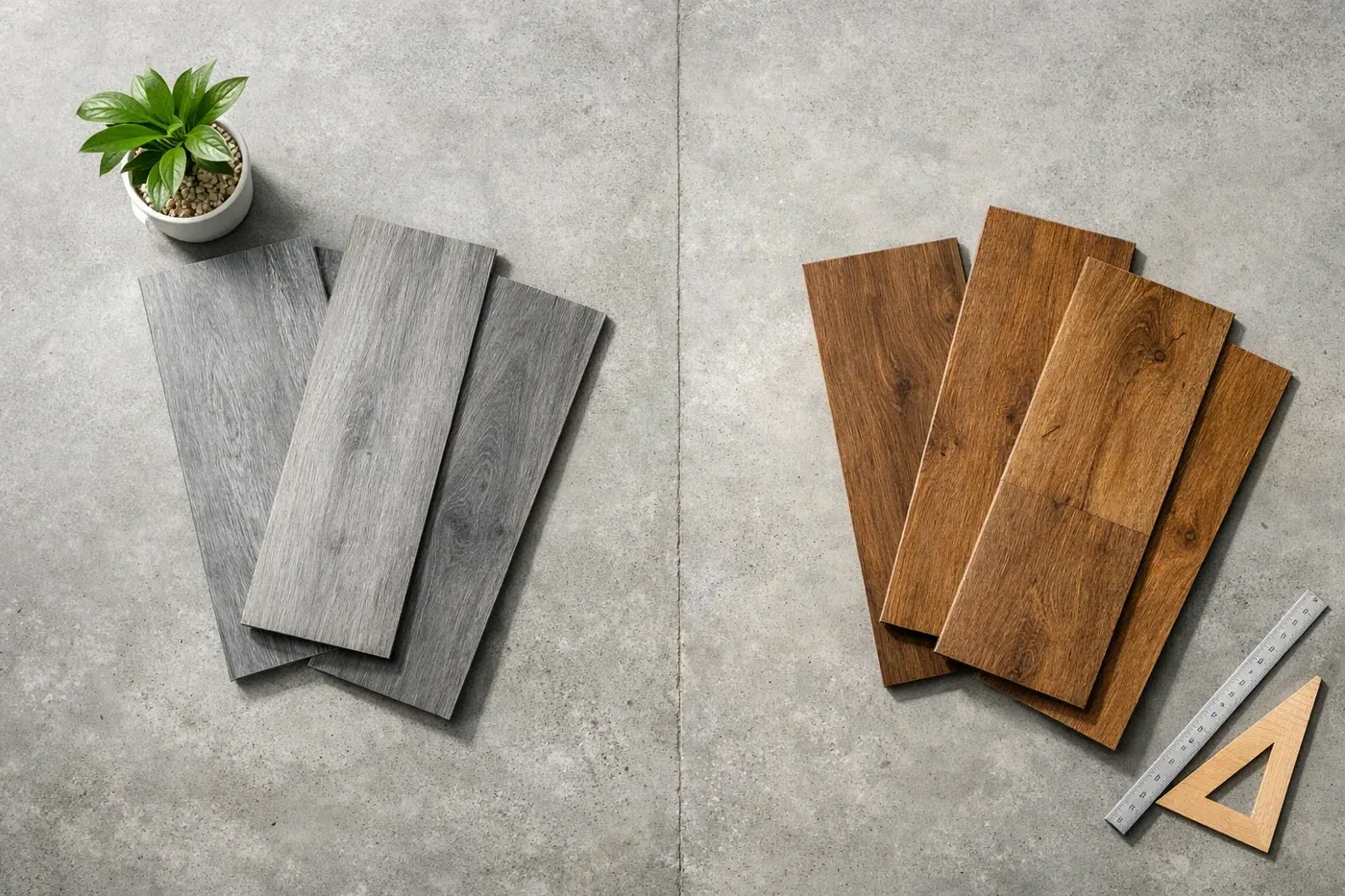
This is where the conversation has genuinely changed over the last few years. Today's water-resistant laminate uses high-resolution digital printing with deeper embossing-in-register textures than hybrid. Side by side in our showroom, the laminate boards consistently read as the more realistic timber — the grain detail, the colour variation board to board, and the surface texture are typically a step ahead of the equivalent hybrid product.
Hybrid still has a place in the range — specifically where you need water tolerance beyond the 48-72 hour exposure window that most quality water-resistant laminates are warranted to. For most kitchens, laundries, mudrooms, and ground-floor open-plan with pets and kids, that 48-72 hour buffer is almost always enough to catch a spill before it becomes a problem, and laminate handles those rooms perfectly. Hybrid only really earns its keep over laminate in the genuinely demanding scenarios: an undetected dishwasher leak that runs for a week, a washing machine hose that fails while the family is away, or a holiday house where a spill might sit for days. If that risk profile is real for the project, hybrid is worth specifying. For upstairs glazed open-plan, where moisture exposure is essentially never the threat, hybrid does not earn that position — laminate is the better technical choice. For a full side-by-side comparison, see our guide to hybrid vs laminate flooring.
The third option — engineered timber
For upstairs installations on chipboard where the brief is the best floor the project can specify, engineered European Oak is also worth considering. Engineered timber is genuinely well-suited to a chipboard subfloor — the cross-laminated core of a quality engineered board is more stable than either solid timber or hybrid in this environment, and unlike a printed product, what you see is what it actually is.
The trade-offs are cost (typically 2-3× the supplied price of hybrid) and the requirement for direct-stick installation in herringbone and chevron formats, which adds further labour cost. For an upstairs installation where the budget allows it, engineered Oak on chipboard with a direct-stick install is a genuinely strong specification. Browse our European Oak hardwood floors and European Oak herringbone flooring to see the range.
The cost conversation
Hybrid upstairs on chipboard sits in the order of around $60 to $110 per square metre supplied and installed in Melbourne in 2026, depending on the specification (8mm plank at the entry, 12mm SPC at the upper end). Water-resistant laminate sits in a broadly comparable range — the top of the laminate range and the top of the hybrid range usually overlap rather than one consistently sitting above the other. Engineered European Oak floating sits around $110 to $175 per square metre supplied and installed; direct-stick around $140 to $205; herringbone direct-stick around $160 to $235.
The full cost breakdown for each category is in our Melbourne hybrid flooring cost guide for 2026, but the headline for builders running a job: the cost differential between hybrid and laminate is typically small enough that it should not be the deciding factor. The deciding factor is whether the upstairs environment will be managed.
What we will not install on chipboard upstairs
For completeness, three specifications we will not quote or install on an upstairs chipboard floor with significant glazing, regardless of what the homeowner asks for:
Solid timber. Solid hardwood on chipboard is fighting a losing battle with the subfloor moisture differential. We specify engineered timber every time.
Bargain-bin hybrid (anything under $25/m² supplied). The thin SPC core (4-5mm), the thin wear layer (0.2-0.3mm), the unproven click-lock systems, and — critically — the EVA foam backing on most products at this price point simply cannot manage the upstairs thermal environment. EVA softens at 75-85°C, well inside the range an unshaded upstairs Melbourne floor will hit during summer. We have replaced too many of these.
Hybrid laid without a separation layer. No exceptions. The builder's plastic is a manufacturer install requirement for moisture management, and on a chipboard subfloor it is also what prevents foam-backing failure (EVA softening or IXPE degradation) from locking the floor to the substrate. Once that locking happens it is irreversible, and the warranty will not cover it.
The conversation to have before signing the order
Builders, this is for you. When you bring an upstairs hybrid job to us — particularly in a contemporary Balwyn, Kew, Hawthorn, Camberwell, or Bayside new-build with significant northern or western glazing — we will almost always raise the laminate option in our quote. That is not us trying to upsell or downsell; it is us trying to ensure that in three years' time, when the family is sitting in the room they spec'd, the floor under them is performing the way they expected it to.
Bring the client to either of our showrooms. We will lay hybrid and water-resistant laminate samples side by side, talk through the technical differences in plain language, walk through the homeowner conditions for whichever they choose, and quote both options. The decision is the client's. Our job is to make sure it is an informed decision.
Frequently Asked Questions
Can I install hybrid flooring on a chipboard subfloor?
Yes, hybrid can be installed on chipboard subfloors when the install follows the manufacturer's standards: perimeter expansion gaps to AS 1884, control joints sized to the manufacturer's raft size, and a 1mm black builder's plastic separation layer between the chipboard and the hybrid. The chipboard itself must be sound, level, and properly fixed to the joists.
Can I install hybrid flooring upstairs?
Yes, but upstairs is the highest-risk environment for hybrid. The combination of low subfloor thermal mass, direct solar gain through upstairs glazing, and the natural thermal stack effect makes upstairs rooms run measurably hotter than downstairs. Hybrid will perform if the install is to standard and the homeowner manages temperature and shading. For most upstairs installations with significant glazing, water-resistant laminate is the technically better choice.
What is yellow tongue chipboard?
Yellow tongue is the brand name (Carter Holt Harvey) for the structural particleboard subfloor panels used in the vast majority of two-storey Australian homes built since the early 1990s. The panels have a tongue-and-groove edge and are glued and screwed together to form a continuous structural floor above the joists.
Why does hybrid flooring need a builder's plastic on chipboard?
The primary purpose of the 1mm black builder's plastic is moisture management — it is the moisture barrier between the subfloor and the hybrid, and it is a manufacturer install requirement on every install regardless of subfloor type. On a wooden subfloor specifically, it also performs a useful secondary function: it provides a continuous low-friction interface so that if the pre-laminated foam backing on the hybrid softens, partially fuses, or degrades under thermal load (more likely with EVA-backed bargain hybrid, less likely with IXPE-backed mainstream hybrid), the floor can still slide independently of the subfloor and manage seasonal thermal movement.
What is the maximum size of a hybrid floor without a control joint?
Control joints are sized by the length of any unbroken run of flooring — the "raft size" — not by total floor area alone. As a rule of thumb, most hybrid brands warrant a maximum raft size of around 10-12 metres in any one direction, with the exact figure varying by brand, board format, and core type. A long narrow run will need a control joint at a much smaller total area than a square open-plan room of the same square-metre count. Always defer to the manufacturer's published install standard for the specific product.
What temperature can hybrid flooring tolerate?
This is the question most homeowners get wrong, because there are actually three different temperatures in play and they are not the same. The outside air temperature on a hot summer day is what you hear on the radio — say, a 35°C day. The room temperature inside an upstairs space with significant glazing is usually meaningfully higher than that, because heat gets in through the glass faster than it gets out through the walls and roof, and because the thermal stack effect concentrates heat upstairs. The floor surface temperature is then higher again, because the floor is absorbing direct solar radiation through the window onto a surface that may be in shadow nowhere all afternoon. Each step adds load. That floor surface temperature is what the hybrid product actually experiences — not the air temperature outside, not the temperature the room thermostat reads. This is why active shading and active cooling matter so much, and why a closed-up upstairs in summer is the worst environment hybrid is ever asked to live in. The specific operating ranges vary by manufacturer and product — always defer to the install standard for the specific hybrid being installed.
Is hybrid flooring better than laminate upstairs?
No. For most upstairs installations with significant glazing, water-resistant laminate is the technically superior choice. Laminate's HDF core is dimensionally more stable across the seasonal swing than hybrid's PVC core, the laminate surface is harder wearing, and modern digital printing produces a visually more realistic timber finish than equivalent hybrid products.
Does my hybrid warranty cover thermal damage?
Manufacturer warranties on hybrid flooring typically exclude damage caused by operating the floor outside the specified temperature range, by undersized perimeter expansion gaps, by missing control joints, or by installation without the specified separation layer. Read the warranty carefully — most thermal-movement failures are excluded.
Visit a showroom
We don't run online forms. The fastest way to get specific advice on whether hybrid, laminate, or engineered timber is the right call for your upstairs project is to bring the floor plan into one of our showrooms.
Nunawading — 341-343 Whitehorse Road, Nunawading VIC 3131. Open 7 days 10am–5pm. (03) 9894 4688.
Hawthorn East — 620-622 Burwood Road, Hawthorn East VIC 3123. Open Mon–Sat 10am–4pm, closed Sundays. (03) 9696 9998.
Bring the floor plan with window orientations marked, the approximate square metre area, and a sample of any joinery or wall colour you want the floor to work with. We will lay samples side by side, walk through the conditions for each, and give you an honest answer about which product is the right answer for the room.
Anthony, Derek & the entire team.
Published by The Flooring Centre — Melbourne's premium carpet and flooring superstores. Visit our Nunawading and Hawthorn showrooms.