| Tier | Price (supply only) | Typical thickness | Wear layer | Where you find it |
|---|---|---|---|---|
| Bargain bin / clearance | $15–$25/m² | 4–5mm SPC | 0.2–0.3mm | Marketplace listings, end-of-line, liquidation |
| Hardware chains | $16–$39/m² | 5–6.5mm SPC | 0.3mm or unstated | Major big-box retailers |
| Discount / online | $30–$45/m² | 5–7mm SPC | 0.3–0.5mm | Online-only retailers, warehouse outlets |
| Specialist entry | $35–$45/m² | 7mm SPC | 0.3–0.5mm | Genuine flooring stores |
| Specialist mid-range | $45–$55/m² | 7–8mm SPC | 0.5mm | Genuine flooring stores |
| Specialist premium | $55–$70/m² | 9–12mm SPC or EPC core | 0.5–0.7mm | Genuine flooring stores |
By The Flooring Centre Technical Team
If you've spent the last few months pricing hybrid flooring in Melbourne, you've probably noticed something strange: the price gap between the cheapest hybrid and the mid-tier hybrid is enormous, and getting wider. The major hardware chains have 5mm SPC hybrid on the shelf for as little as $16 per square metre. Genuine flooring specialists rarely sell anything under $35. Some premium hybrid sits north of $70.
The instinct is to assume the difference is just margin — that the specialist is charging more for the same product. That instinct is wrong. The difference reflects an entirely different category of product, manufactured to entirely different specifications, with entirely different failure modes. And the gap exists right now, in 2026, because of a global trade situation that has very little to do with flooring and everything to do with where China can sell what it makes.
This is the honest guide to hybrid flooring cost in Melbourne in 2026 — what the price tiers actually represent, why the bottom of the market got so cheap, and what we'd recommend after fifty-plus years of laying floors that have to last.
Hybrid Flooring Cost in Melbourne 2026 — At a Glance
For readers who want the practical numbers first, here is the current Melbourne pricing landscape (April 2026):
For fully installed pricing, our typical Melbourne project range is $60–$110/m² depending on the format you choose: standard plank installation sits at the lower end, while chevron and herringbone parquetry installation — with their angled cuts, tighter tolerances and substantially more handling per square metre — sit at the higher end. A 100m² home fully installed in mid-tier plank hybrid lands in the order of $6,000–$8,500; the same home in chevron or herringbone hybrid sits closer to $9,000–$11,000 because the layout and labour change, not because the product is dramatically more expensive.
12mm Hybrid Flooring Price (Melbourne 2026)
12mm hybrid flooring sits at the top of the residential hybrid spectrum and typically prices in the order of around $55 to $70 per square metre supplied. The premium over 8mm and 9mm hybrid pays for two things — a thicker rigid SPC or EPC core (which improves dimensional stability across thermal cycles) and a larger acoustic mass that meaningfully reduces impact noise transfer. For fully supplied-and-installed pricing in Melbourne, a 12mm specification typically lands at around $95 to $130 per square metre for standard plank, depending on subfloor condition and access. We rarely recommend 12mm for ground-floor slab installations — the additional core thickness offers no functional benefit there. Where 12mm earns its premium is upstairs over timber subfloors and in two-storey homes where the additional acoustic mass is genuinely useful.
Why the Cheap End Got So Cheap (2025–2026)
The $16/m² price point at the major hardware chains did not appear because hybrid flooring suddenly got easier or cheaper to make. It appeared because of three converging forces in the global flooring trade — none of which Australian consumers ever read about.
1. China is sitting on an enormous flooring surplus
Chinese factories built for the booming domestic property market are now running well below capacity. Property is the central problem: new home sales in China fell 14.1% in 2024 — the lowest level since 2009 (GAM Investments, citing China NBS data) — and have continued falling through 2025. With an estimated 80 million unsold homes and the property slump now in its fifth consecutive year (Atlantic Council, January 2026), Chinese demand for flooring has collapsed.
At the same time, PVC raw material capacity in China has continued expanding — approximately 1.7 million metric tonnes per year of new output by the end of 2025 (S&P Global Commodity Insights, July 2025). The result is an SPC-grade PVC oversupply that has to find a market.
2. The American market closed
Until 2025, the United States was the world's largest flooring market and a major destination for Chinese SPC and luxury vinyl. That door is now mostly shut. The Trump administration's tariff escalations through 2025 raised the effective tariff on Chinese SPC and LVT to nearly 50% on average — and reached as high as 145% during the April 2025 reciprocal-tariff period.
The trade impact was immediate. Chinese flooring imports to the US fell 45.6% year-on-year in 2025; LVT specifically fell 54.3% (Floor Daily, February 2026). Several major Chinese SPC manufacturers have responded by building production facilities outside China — typically in Vietnam — to bypass US duties. The Vietnamese-route product still carries the same Chinese formulation engineering and the same upstream supply chain; the change is the country stamp on the box.
The product that was destined for American homes has had to go somewhere.
3. Australia has the most open flooring market in the developed world
Under the China–Australia Free Trade Agreement (ChAFTA), SPC and hybrid flooring (HS classification 3918.10) enters Australia at 0% tariff. There are no anti-dumping duties currently in place on Chinese SPC. Compare this to:
- United States: 25% Section 301 + additional reciprocal tariffs = effective rates of 50%+ through 2025
- Canada: anti-dumping duties up to 87% on Chinese vinyl tile imports
- EU: anti-dumping duties on Chinese ceramic tile, with similar instruments available for vinyl
Australia is, structurally, one of the most open markets globally for Chinese flooring. The Reserve Bank of Australia explicitly confirmed in its August 2025 Statement on Monetary Policy that "Australian imports from China have risen sharply" as a direct result of US trade redirection. Parallel building products show the same pattern — imports of laminated veneer lumber from China to Australia rose 63% year-on-year in 2025, with China's share rising 107%.
The combination of Chinese surplus, the closed US market, and Australia's 0% tariff creates the conditions for $16/m² SPC in the big-box channel. None of this is illegal. None of it is unusual in trade terms. It is, however, the explanation for why the cheap end of the Australian hybrid flooring market got suddenly, dramatically cheaper in 2025–2026 — and why that price tier may not behave the way the showroom display suggests.
What Actually Sits at $16/m²
The cheapest hybrid in the major hardware-chain channel as of April 2026 is a 5mm SPC plank, priced from $16/m². Product descriptions at this tier typically claim:
- 100% waterproof
- 20-year residential warranty
- An in-house "star rating" wear layer for high foot traffic
- Pre-adhered 1mm EVA foam underlay
- No fade or expansion in response to sun exposure
These claims read confidently. Here is what they don't tell you.
The "star rating" wear layer language at this tier is the brand's own internal label. There is no Australian, ISO, or international standard for SPC wear layers expressed as stars. The wear layer thickness — the actual technical specification — is rarely stated in mil or mm at this price point. By comparison, genuine specialist hybrid products list 0.3mm, 0.5mm, or 0.7mm wear layers explicitly, because customers ask.
The 5mm total typically includes a 1mm pre-adhered foam underlay, which means the actual SPC plank is 4mm thick. That matters for reasons we explain in the next section.
The "no fade or expansion in sun" claim sits uneasily next to the manufacturer-published light fastness data of premium laminate brands and the absence of equivalent UV testing data on cheap SPC. PVC is not inherently UV-stable; it requires UV stabilisers in the formulation. Whether they are present in adequate concentrations in a $16/m² product is not something the consumer can verify.
The 20-year warranty is a marketing instrument, not a service-life prediction. Read the warranty document closely and the exclusions are extensive: installation conditions, subfloor preparation, sun exposure, traffic class, claim documentation. In our trade experience, warranty claims on this tier of product almost never pay out.
A Note on How Hybrid Thickness Is Quoted (And the Question to Ask)
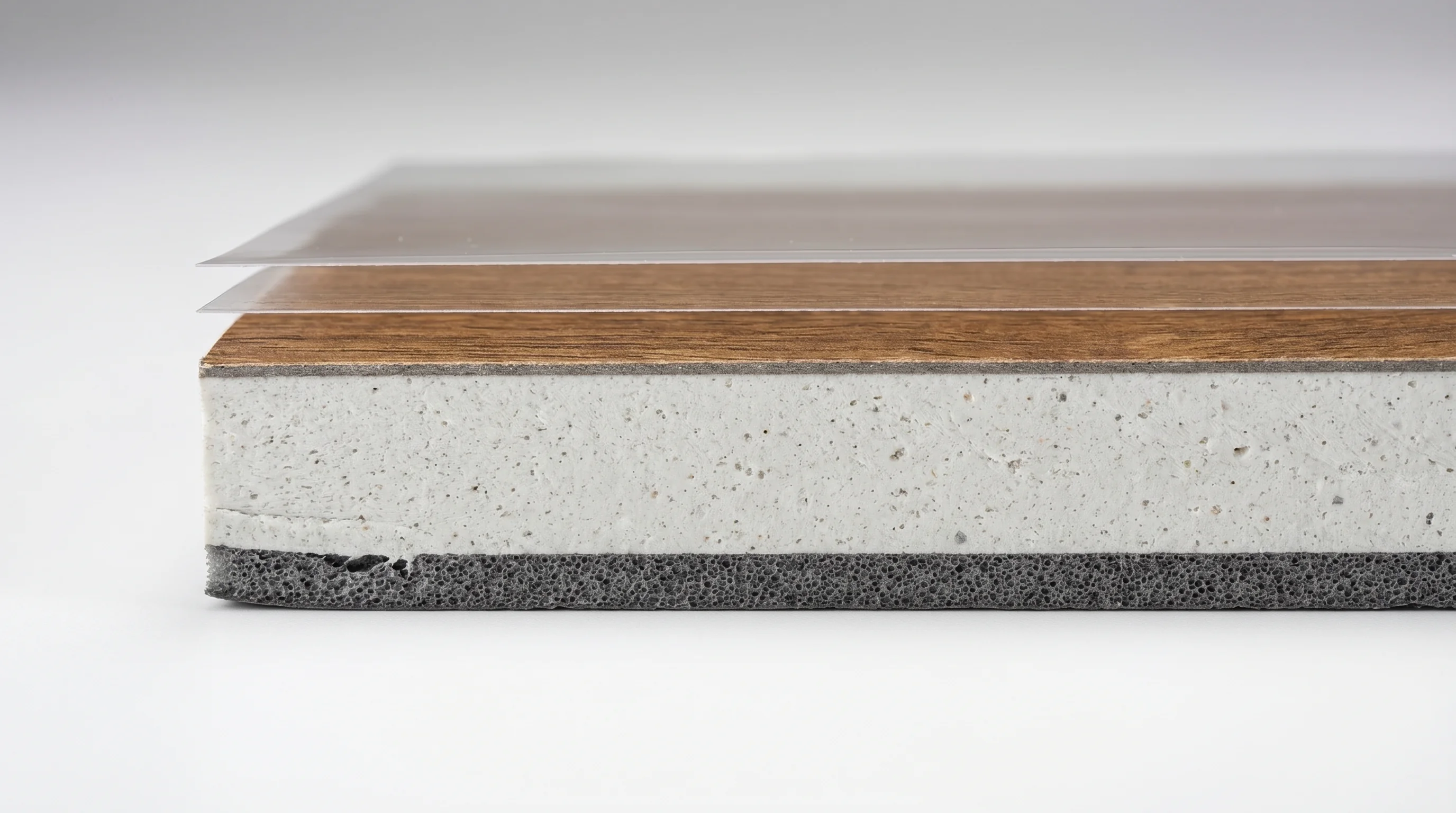
Before we get to failure modes, there is one industry detail every buyer needs to understand: hybrid flooring is quoted as a total thickness that includes the pre-attached underlay. This is industry-wide — specialists and hardware chains alike. A product sold as "7mm hybrid" is most often a 5mm SPC plank bonded to a 2mm foam underlay. The total stack is 7mm; the structural plank is 5mm.
The convention itself is not the problem. The problem is that the structural performance of a hybrid floor — lock strength, telegraphing resistance, click-lock fatigue — is a property of the plank, not the stack. A 5mm plank under a 2mm foam pad will perform like a 5mm plank, click like a 5mm plank, and fail like a 5mm plank, regardless of what the box says on the front.
The most consequential reason this matters is the click-lock geometry. A click-lock joint is machined directly into the edge of the plank — a small tongue and groove cut from the structural core itself. The dimensions of that lock profile are constrained by the thickness of the plank it's cut from. A thicker structural plank gives the manufacturer more material to work with, which generally translates to a more substantial lock geometry, more material engaging across the joint, and better resistance to the forces of installation, thermal cycling, and foot traffic. A 5mm-cored plank constrains the lock profile in ways an 8mm or 9mm plank does not. In our trade experience, the locks are usually the first thing to fail on under-specified hybrid — and once a lock fails, the joint is permanent.
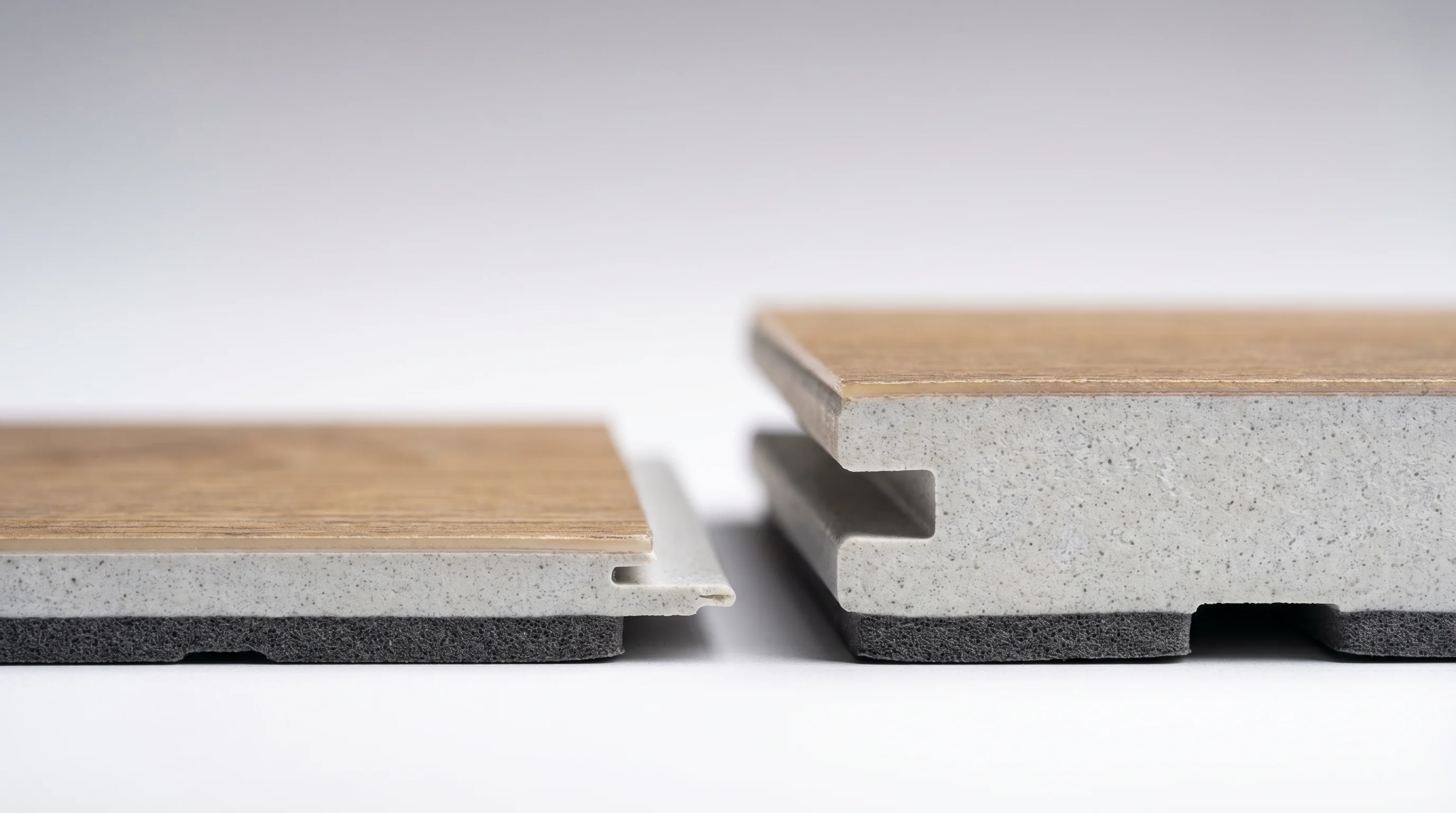
It also matters because the thicker the included underlay, the cheaper the product is to manufacture. Foam is dramatically cheaper per millimetre than rigid SPC core. A product advertised at "8mm with 3mm underlay" is a 5mm plank with an inflated total dimension. A genuine 8mm hybrid — 8mm of structural plank — is a categorically more expensive product to make and to buy.
There is also a mechanical consequence. A 2–3mm foam underlay introduces too much vertical compliance under foot traffic. The plank surface deflects downward as you walk on it; the click-lock joint between adjacent planks experiences cyclic vertical movement; over time, the joint fatigues and fails. We see this failure pattern most often in products with thick included pads paired with thin structural cores.
The question to ask when comparing hybrid quotes — of any retailer, including us — is: what is the plank thickness, and what is the underlay thickness? Both numbers should be available on a product spec sheet. If the spec sheet only states the total, that's the conversation worth having before you commit.
Why $16 Hybrid Fails (And the Specific Failure Modes)
Genuine flooring specialists do not sell 5mm SPC at $16/m². It is not a margin choice. It is because we do not believe the product will perform, and we do not want to be the people you call when it fails. Here are the specific mechanisms:
1. The click-lock joint snaps during installation
Click-lock joints rely on a small interlocking tongue-and-groove profile machined into the edge of each plank. On a 4mm SPC core (5mm minus 1mm underlay), there is very little material to machine the lock from. The lock profile becomes thin and fragile.
When the installer tilts and clicks the plank into place, those thin profiles snap. Sometimes during installation. More often, weeks later, when the floor experiences its first thermal cycle and the joints take load. Once a lock breaks, that joint becomes a permanent gap. We have repaired floors where 30% of joints had failed within a year.
There is also a composition factor. Cheap SPC pushes the calcium carbonate content above the optimal threshold to reduce the more expensive PVC content. Industry engineering sources document this clearly: above approximately 75% calcium carbonate, the SPC core becomes brittle, and click-lock breakage is the primary failure mode. Premium SPC keeps calcium carbonate at 60–70%. Whether a $16/m² product hits 75%+ is not something the consumer can verify — and at that price point, the economics push the formulation in only one direction.
2. Thermal expansion runs out of space and snaps the lock from the inside
SPC has a coefficient of thermal expansion of approximately 0.05mm per metre per degree Celsius. In an Australian home with significant north- or west-facing glazing, surface floor temperatures in summer can hit 50–70°C. Over a 10-metre run, a 30°C temperature rise produces 15mm of expansion.
Manufacturers compensate for this with mandated expansion gaps at perimeters — the gap your skirting boards hide. Quality products specify these gaps clearly and the boards have enough lock strength to survive the cyclic loading. Cheap thin-core SPC doesn't. When the floor hits its expansion limit, the force has to go somewhere. It goes into the click-lock joints, and they fail from the inside out — a fracture pattern we see regularly when called to assess hardware-chain hybrid that has buckled or peaked.
This is also why most cheap product warranties explicitly exclude sunrooms and direct-solar-gain rooms — the product is not technically suitable for the conditions it is being sold into, and the manufacturer knows it.
3. Telegraphing — every imperfection in the subfloor eventually prints through
All hybrid flooring telegraphs to some degree — every nail head, every trowel ridge, every grout line if it has been laid over tile, eventually shows through to the surface. You feel it underfoot first. Then you see it in raking light. Then it is permanent. This is a property of the category, not a defect.
What changes with thickness is the severity and the time-to-visible. A 4mm SPC plank with a 1mm foam underlay has very little ability to bridge subfloor irregularities; problems appear within months. A thicker structural plank — 7mm, 8mm, or above — bridges minor irregularities more effectively and reveals them more slowly, but it does not eliminate the issue. The right defence against telegraphing is rigorous subfloor preparation before installation, not the assumption that a thicker plank will hide a poor subfloor.
This is one of the reasons specialist hybrid quotes include a documented subfloor preparation specification, and cheap product does not. The cheap product assumes the subfloor is fine; the specialist assumes it usually isn't.
4. Hollow sound and tinny acoustics
If you've ever walked across a cheap SPC floor and noticed it sounds hollow underfoot — like tapping on a thin plastic shell — that is the calcium-carbonate-loaded PVC core transmitting sound rather than absorbing it. Combined with the thin 1mm foam underlay, the result is an acoustic experience that disappoints buyers within weeks. There is no way to fix this after installation.
Premium hybrid pairs a higher-density core (≥1.95 g/cm³) with a 1.5mm or 2mm acoustic-rated underlay, often with a 4-star or 6-star acoustic certification. The price difference goes directly into the acoustic experience.
What You Actually Get at Each Price Tier
Stripping the marketing away, here is what each price tier represents in technical specification.
$15–$25/m² (clearance, marketplace, hardware bottom)
- 4–5mm total thickness, often 4mm SPC + 1mm foam underlay
- 0.2–0.3mm wear layer (or unstated)
- 70–80%+ calcium carbonate composition
- Thin click-lock profile, prone to installation failure
- Mostly direct China-import, often unbranded or rebadged
- 1mm pre-adhered foam underlay (no acoustic rating)
- Warranty present but typically unclaimable in practice
$25–$40/m² (hardware chains regular range)
- 5–6.5mm total thickness
- 0.3mm wear layer
- Better but still cost-optimised composition
- Brand-named, but rarely the brands you'd find at a flooring specialist
- Warranty 15–25 years residential (read exclusions)
- Some products genuinely performant; quality varies dramatically by SKU
$35–$45/m² (specialist entry-level)
- 7mm SPC, 0.3–0.5mm wear layer
- Composition managed for click-lock integrity (60–70% CaCO₃)
- Recognised specialist-channel brands with documented technical data sheets
- 20-year residential warranties that the brand will honour in practice
- Foam or basic acoustic underlay attached
- Suitable for medium-traffic family homes
$45–$55/m² (specialist mid-range)
- 7–8mm SPC, 0.5mm wear layer (commercial-residential class)
- Established specialist brands with full technical documentation
- 25-year warranties, transferable on premium brands
- 1.5mm acoustic underlay, often 4-star rated
- The right specification for most Melbourne homes — and the tier we install most frequently
$55–$70/m² (specialist premium)
- 9–12mm hybrid, often EPC cores rather than pure SPC
- 0.5–0.7mm wear layer (heavy commercial)
- Premium specialist brands with rigid-core technologies and acoustic certifications
- Lifetime or 30-year transferable warranties
- 6-star acoustic underlay
- Available in plank, chevron, and herringbone formats
- The specification you'd choose for a premium renovation, indoor-outdoor flow, or high-traffic commercial-grade residential
The Water-Resistant Laminate Counter-Argument
There is a category most flooring buyers don't consider when they're shopping hybrid, and they should: water-resistant laminate. At the same $40–$50/m² price point where hybrid sits in mid-range, water-resistant laminate frequently delivers better real-world performance.
Scratch resistance. Laminate uses an aluminium-oxide-infused melamine wear layer. Aluminium oxide rates 9 on the Mohs hardness scale — second only to diamond, and harder than the quartz grit that scratches floors. Premium water-resistant laminate carries an AC4 or AC5 abrasion class rating under EN 13329. Hybrid SPC tops out with a polyurethane wear layer at Mohs 2–4. In a household with dogs, kids, and chair feet, the laminate wear layer will outlast the hybrid wear layer — sometimes by years.
UV stability. Premium water-resistant laminate is routinely rated Class 8 (the maximum) on the EN ISO 105 B02 light fastness scale. SPC manufacturers rarely publish equivalent UV data, and visible fading on darker SPC products is documented within 5–10 years in direct Australian sun.
Stain resistance. Premium laminate carries a Class 5 EN 438 stain rating. The thermoset surface is chemically inert.
Flame resistance to surface ignition events. This is the practical, household-level question — a knocked-over candle, a dropped match, an ember from a fireplace landing on the floor. Laminate's thermoset melamine wear layer is a cross-linked polymer that resists ignition and does not melt or drip under direct flame at low intensity. The PVC topcoat on hybrid SPC ignites at a lower temperature and melts as it burns, leaving a permanent surface mark even when the flame is extinguished quickly. Both materials achieve their respective regulatory fire classifications under EN 13501-1 — the SPC's mineral core actually scores one class higher in the broader fire rating — but for the specific case of a small ignition event on the surface, premium laminate handles it more cleanly.
Embossing realism. Laminate's HDF core can hold deeper embossed-in-register (EIR) patterns than the printed PVC film on SPC at the same price. The result is a more convincing timber appearance, particularly at viewing distance.
Thermal stability in sunrooms. This is the situation where laminate genuinely outperforms hybrid. SPC's pure-PVC core expands more aggressively in direct solar gain than laminate's HDF core. Floating SPC installations in sunrooms and rooms with large north-facing glazing routinely peak or buckle; quality water-resistant laminate handles these conditions without issue.
In the $40–$50/m² range, this is not a one-size-fits-all answer, and we sell both products. The specifications that matter — wear layer hardness, UV class, stain class, ignition behaviour, thermal stability — are routinely better on premium water-resistant laminate at this price point. The only way to know which is right for your home is to compare them side by side on the basis of their actual technical specifications, not their marketing language.
What We Recommend
Three honest pieces of advice based on what we install.
For most Melbourne homes: $35–$55/m² specialist hybrid (7–8mm structural plank, 0.5mm wear layer, quality acoustic underlay, 25-year warranty) is the genuine sweet spot. It will perform for 15–20 years with normal residential use, and the warranty actually pays out.
For high-traffic rooms, indoor-outdoor flow, or kitchens that take a hammering: 9–12mm premium hybrid with an EPC core and 0.7mm wear layer. The price step from $50 to $70/m² buys a specification that genuinely performs differently — denser or more dimensionally stable core, less severe telegraphing, better acoustics, better long-term appearance retention. This is also the tier where parquetry formats — chevron and herringbone hybrid — become available for buyers who want the pattern look without the cost or maintenance of timber parquetry.
For everywhere else: at $40–$50/m², take a serious look at water-resistant laminate. A premium AC4–AC5 water-resistant laminate will outperform a comparable-priced hybrid on scratch resistance, UV, stain, and thermal stability. Hybrid is the more familiar choice, but it is not automatically the right one — the comparison is worth doing on the actual specifications.
What we wouldn't install in a customer's home: 4–5mm SPC at $15–$25/m². Not because the price is bad, but because we don't believe the product will perform, the failure modes are predictable, and the warranty is impractical. If the budget genuinely will not stretch beyond $25/m², we would honestly recommend keeping the existing floor and saving for a year, rather than installing a product that will fail.
Frequently Asked Questions
Why is hybrid flooring at the major hardware chains so cheap?
A combination of three things: Chinese factories are running well below capacity due to a multi-year property market downturn at home; the US market has been effectively closed by 50%+ tariffs; and Australia charges 0% tariff on Chinese SPC under the China-Australia Free Trade Agreement. The product that used to go to American homes is now landing in Australian retail at low prices. The price reflects market conditions, not manufacturing improvements.
Is 5mm SPC hybrid good enough for my home?
For a low-traffic spare room or a rental investment property, possibly. For a primary residence, generally not. The 5mm thickness includes a 1mm pre-adhered underlay, so the actual SPC core is 4mm — which produces a thin click-lock profile prone to breakage, telegraphing of subfloor irregularities, and limited acoustic performance. We recommend 6mm minimum for a home you live in.
Why does my hybrid flooring sound hollow underfoot?
Most often a combination of three factors: a thin or low-density SPC core, a thin foam underlay (1mm or less, no acoustic rating), and the inherently rigid limestone-and-PVC composition transmitting rather than absorbing sound. Premium hybrid pairs a higher-density core with a 1.5–2mm acoustic-rated underlay; the price difference is largely the acoustic experience.
Hybrid vs water-resistant laminate — which is better?
Both are valid Australian specifications and we sell both. Premium water-resistant laminate is often the better technical specification at the same price — harder wear layer (aluminium oxide), better UV stability, better stain resistance, better behaviour under surface ignition events, better thermal stability in direct sun. Hybrid handles incidental moisture better than laminate, but neither is the right specification for full bathrooms with standing water (use sheet vinyl, LVT, or porcelain tile for those). The right answer depends on the room — and the only way to choose is to compare the spec sheets side by side.
How much does hybrid flooring cost to install in Melbourne?
Our typical fully installed range is $60–$110/m², depending on format. Standard plank hybrid installation sits at the lower end of that range. Chevron and herringbone parquetry hybrid sit at the upper end because the angled cuts, tighter tolerances and increased labour per square metre add genuine cost. Subfloor preparation, transition strips, removal of existing flooring and stair installation are additional and quoted separately.
What does ChAFTA mean for hybrid flooring prices?
The China–Australia Free Trade Agreement applies a 0% tariff to SPC and hybrid flooring imported from China. By comparison, the US applies tariffs of 25–145% to the same products, and Canada applies anti-dumping duties up to 87%. Australia is structurally one of the most open markets globally for Chinese-manufactured flooring, which is part of why the cheap end of the market is so cheap.
What thickness should I get?
For most residential use, 7–8mm. Below 6mm, the click-lock joint and telegraphing become serious risks. At 9mm and 12mm, you're paying for premium-tier features (denser cores, better acoustics, longer warranties) that genuinely improve real-world performance in high-use rooms. 5mm and below is suitable only for very low-traffic applications.
How long should hybrid flooring last?
Premium specialist hybrid (9–12mm, 0.5–0.7mm wear layer, properly installed): 15–25 years residential, often longer. Mid-range specialist (7–8mm, 0.5mm wear layer): 12–18 years. Hardware-chain hybrid (5mm or less, 0.3mm or unstated wear layer): typically 5–10 years before noticeable wear, click-lock failure, or telegraphing requires replacement. The warranty length is not a service-life prediction.
Where should I NOT use hybrid flooring?
Sunrooms with large north- or west-facing glazing (thermal expansion exceeds float-installation tolerances). Rooms over heated concrete with poor moisture management. Bathrooms where the floor will see prolonged standing water. For these rooms, the right answer is usually ceramic or porcelain tile, sheet vinyl, or LVT — not floating hybrid.
What's the difference between SPC and hybrid?
In the Australian market the terms are used almost interchangeably, but technically hybrid is the broader category. The two cores currently in the market are SPC (Solid Polymer Core) and EPC (Expanded Polymer Core). SPC is the denser, more rigid core; EPC is softer underfoot, warmer in feel, and slightly more expensive. WPC (Wood Plastic Composite) was a third core type historically; the products formerly described as WPC are now sold as EPC. The vast majority of hybrid sold in Australia in 2026 is SPC, with EPC at the premium end of the market.
The Bottom Line
The $16/m² hybrid in the hardware-chain channel is real. The product behind that price is also real, and the failure modes are predictable. The honest job of a flooring specialist in 2026 is not to convince you that all cheap product is bad — it is to be specific about what you are actually buying and what is likely to happen to it.
If you have a budget that won't stretch beyond $25/m², we'd rather be honest with you than install a product we don't believe in. If you have a $35–$55/m² budget, specialist hybrid in the sweet spot is excellent value and will outlast the cheap tier by a decade. If you have a $40–$50/m² budget, premium water-resistant laminate is genuinely worth comparing alongside the hybrid options.
Visit our Nunawading or Hawthorn East showroom to see the difference between $16/m² hybrid and $45/m² hybrid side by side, in your hand, in real lighting. We'll show you the wear layer, the click-lock profile, the core density, and the acoustic difference, and you can decide what's right for your home from the actual evidence rather than the showroom card.
Book a free measure and quote online or call (03) 9894 4688 (Nunawading) or (03) 9696 9998 (Hawthorn East). The right floor for your home is the one you choose with the full picture in front of you.
For deeper reading on the products and specifications mentioned here, see our hybrid vs laminate flooring, hybrid vs vinyl plank flooring, carpet underlay guide, and best waterproof flooring for bathrooms.
Published by The Flooring Centre — Melbourne's premium carpet and flooring superstores. Visit our Nunawading and Hawthorn showrooms.