By The Flooring Centre Technical Team
There is a moment in almost every premium flooring project when the conversation moves past species and grade and arrives at this question: herringbone or chevron? It sounds deceptively simple. They are both parquetry patterns. They are both associated with sophistication and craft. They are both, at first glance, made of the same small boards laid at angles rather than running straight down the length of the room. And yet they are not the same — not geometrically, not visually, not in what they communicate about a space, and not in what they demand of the installer or the budget.
This is the guide that distinguishes them with precision, and helps you understand which pattern belongs in which room.
Where These Patterns Come From
To understand herringbone and chevron is to understand something about European decorative architecture and the long history of timber floors as objects of status rather than mere practical surfaces.
Both patterns have their origins in the parquetry tradition of sixteenth-century France, where the châteaux of the Loire Valley were among the first to replace stone flags with intricately laid timber floors. The word parquet derives from the Old French parc, meaning a small compartment — a reference to the geometric sections that defined the earliest patterned floor designs. By the seventeenth century, the Palace of Versailles had elevated timber parquetry to a form of royal theatre, with elaborate geometric patterns — including herringbone — covering the floors of state rooms that were expressly designed to impress through material and craft.
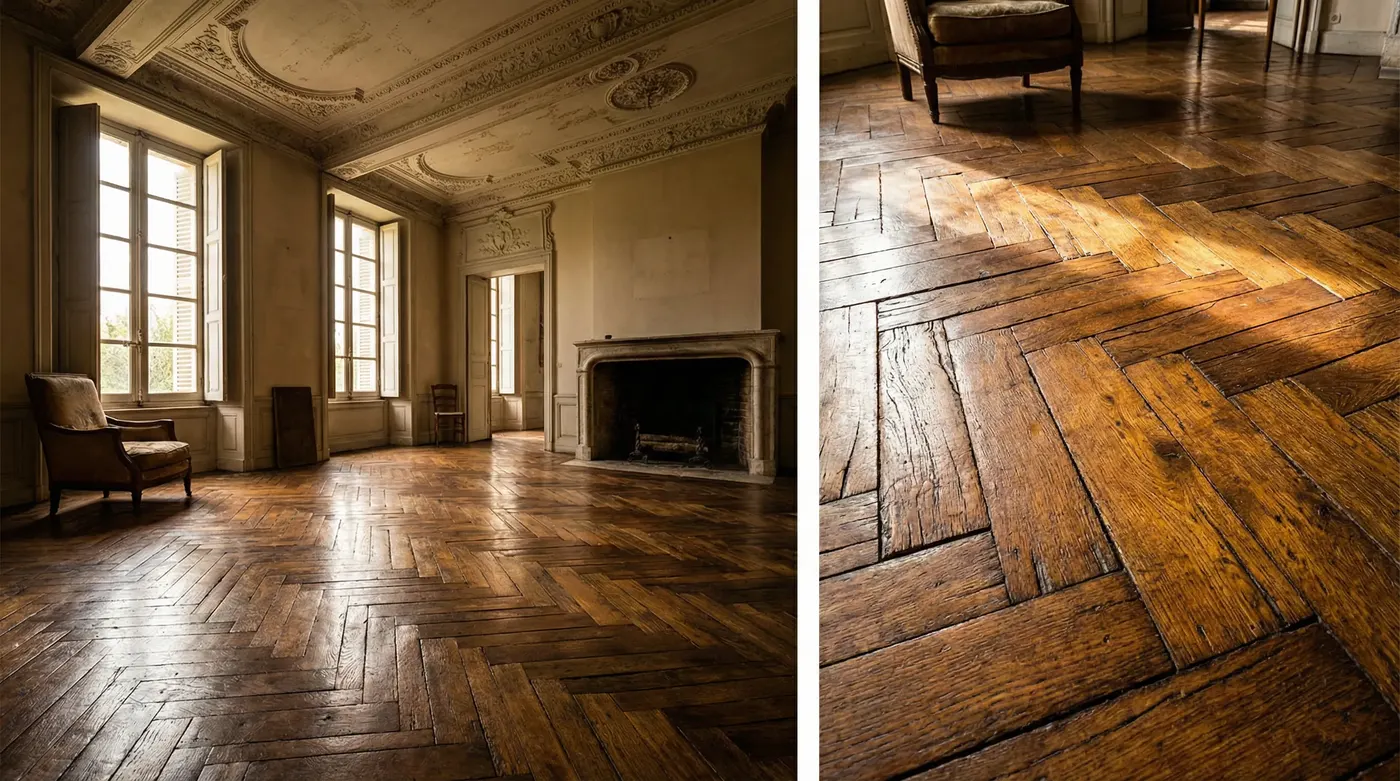
Herringbone was, for centuries, the more prominent of the two patterns. Its design was simple enough to cut and lay efficiently (given the tools of the era) yet geometrically complex enough to communicate the skill of its makers. It appears in Flemish and Italian architecture of the Renaissance period, and its name — a direct reference to the skeletal structure of a herring, the bones fanning out in alternating angles from a central spine — captures its visual logic precisely.
Chevron arrived somewhat later as a refinement of the herringbone principle, requiring the more precise angled cut that gave the pattern its unbroken V-shape. It is the more technically demanding of the two to produce and was traditionally associated with the very highest tier of architectural commissions.
Both patterns experienced a long period of relative dormancy in the twentieth century, when modernist minimalism championed the straight-laid plank as a corrective to Victorian excess. Their current resurgence — sustained now for well over a decade in the premium Australian residential market — reflects a broader appetite for craftsmanship, pattern, and historical depth in interiors that have otherwise become increasingly spare.
The Geometry: Understanding the Actual Difference
This is where most explanatory articles go wrong, describing the two patterns in ways that conflate rather than distinguish them. The difference is fundamental and worth understanding precisely.
Herringbone
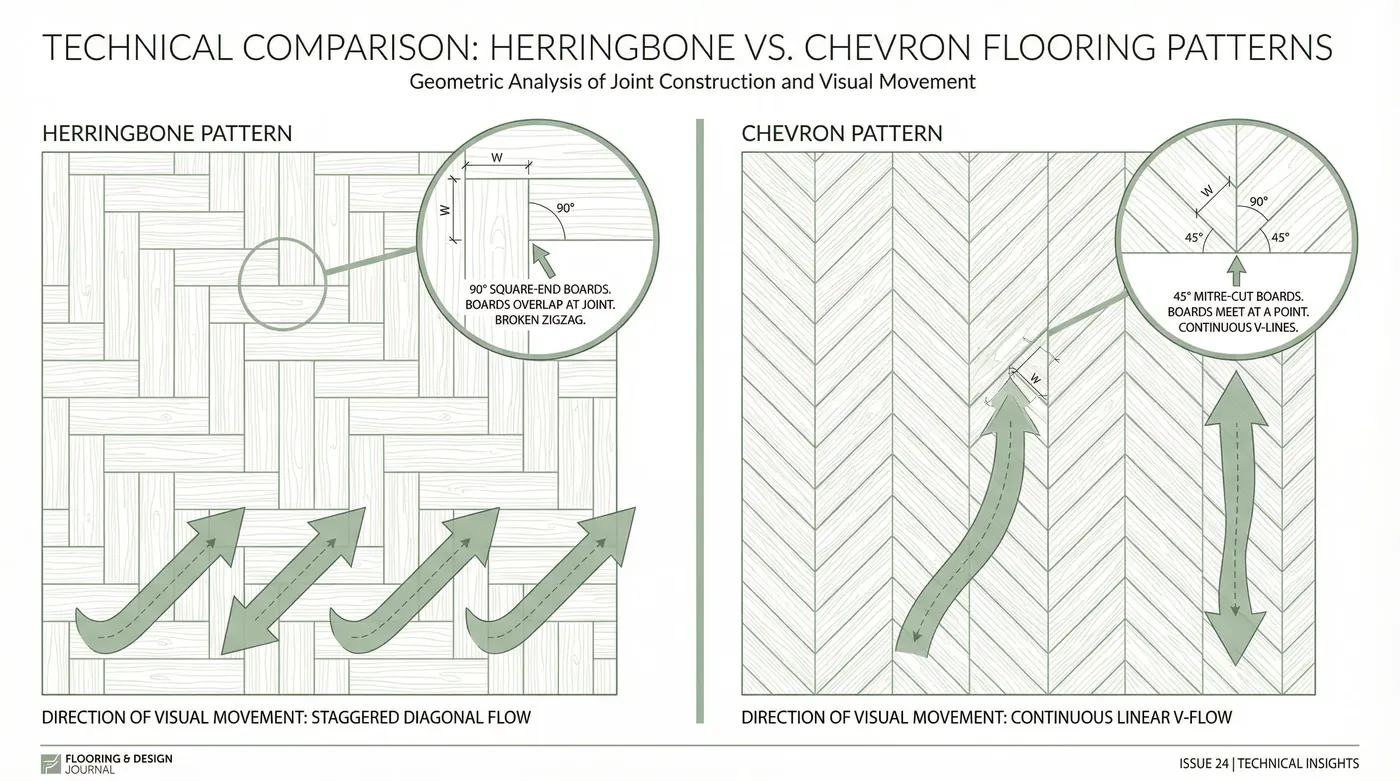
In a herringbone pattern, rectangular boards of consistent dimensions are laid at 90-degree angles to one another, in alternating courses. Critically, the ends of the boards are cut at right angles — perfectly square. The resulting pattern creates a broken zigzag: the boards in each course run in one direction, and the adjacent boards run perpendicular to them, so that the end of one board meets the long face of the next. No two adjacent boards are ever running in the same direction.
Visually, this produces a pattern with a directional quality — it reads diagonally across the room — but the effect is somewhat fractured and textural: the eye is caught by the constant interruption at the board ends, creating a sense of movement that is rich, busy, and artisanal in character.
Chevron
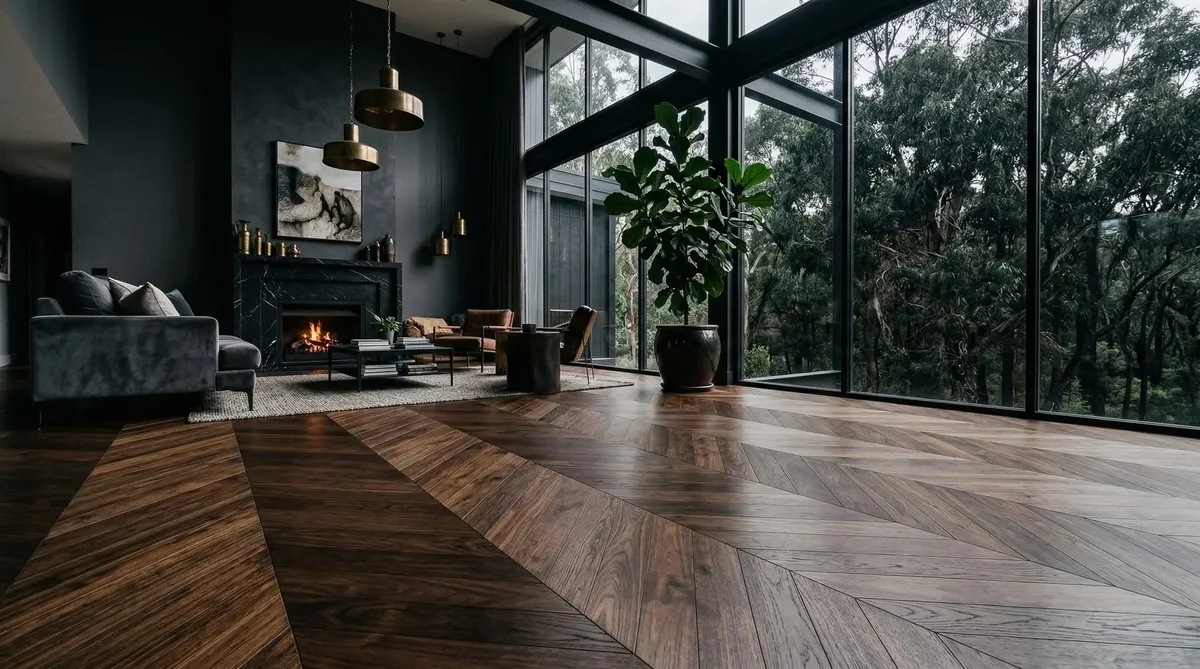
In a chevron pattern, the boards are cut at an acute angle at each end — typically 45 degrees, though 60-degree cuts are also used for a more compressed, elongated V. Rather than meeting end-to-face as herringbone boards do, chevron boards meet tip-to-tip: each mitre-cut end meets the corresponding mitre-cut end of the opposing board. This creates a continuous, unbroken V-shape that travels across the floor without interruption.
The visual effect is fundamentally different from herringbone: where herringbone is textural and busy, chevron is fluid and directional. The continuous V guides the eye with an architectural purposefulness that feels more contemporary, more graphic, and more controlled. There are no broken ends interrupting the movement — just a clean, rhythmic geometry.
A Practical Illustration
The easiest way to commit the difference to memory: if you lay two pencils in a herringbone arrangement, their ends do not meet — the side of one pencil aligns with the end of the other. If you lay two pencils in a chevron arrangement and sharpen both ends to the same angle, the sharpened tips meet perfectly at the apex of the V. The first produces a broken, stepping zigzag; the second produces a clean, continuous arrow.
Visual Impact: What Each Pattern Does to a Room
Understanding the visual psychology of these patterns matters as much as understanding their geometry.
Herringbone: Texture, Warmth, and Complexity
Herringbone creates a floor that commands attention through visual density. The alternating 90-degree courses generate a surface that reads as intricate and detailed — close up, the individual boards and their grain are legible; from a distance, the overall geometry asserts itself as a kind of textile quality, not unlike a fine tweed or a woven fabric viewed from across the room.
This density is an asset in spaces where richness is the goal. A herringbone floor in a formal dining room, a study, a library, or a heritage entrance hall does something straight plank cannot: it contributes material weight and historical resonance. The pattern has been in continuous architectural use for five centuries for good reason.
However, that same density becomes a liability in spaces where simplicity and calm are the design objectives. A herringbone floor in a small bedroom, a compact powder room, or a room with multiple competing visual elements — bold wallpaper, patterned textiles, elaborate cabinetry — can feel overwhelming. The pattern demands to be the dominant element in the room.
Chevron: Dynamism, Direction, and Contemporary Elegance
Chevron operates differently. Its continuous V-shape creates a directional energy that is simultaneously dynamic and controlled. Unlike herringbone, which distributes visual attention across the textured surface, chevron guides the eye forward — along the direction of the V — with a sense of purpose that feels almost architectural, like an arrow drawn on the floor.
This directional quality is one of chevron’s most powerful design tools (discussed further below), and it gives the pattern a contemporary sensibility that herringbone, with its busier texture, does not quite possess. Chevron reads as sophisticated and intentional — the choice of a designer who has made a deliberate spatial decision — where herringbone reads as traditional and characterful.
Board Dimensions: What Works for Each Pattern
Board dimensions are not decorative — they are structural to whether a pattern reads correctly.
For Herringbone
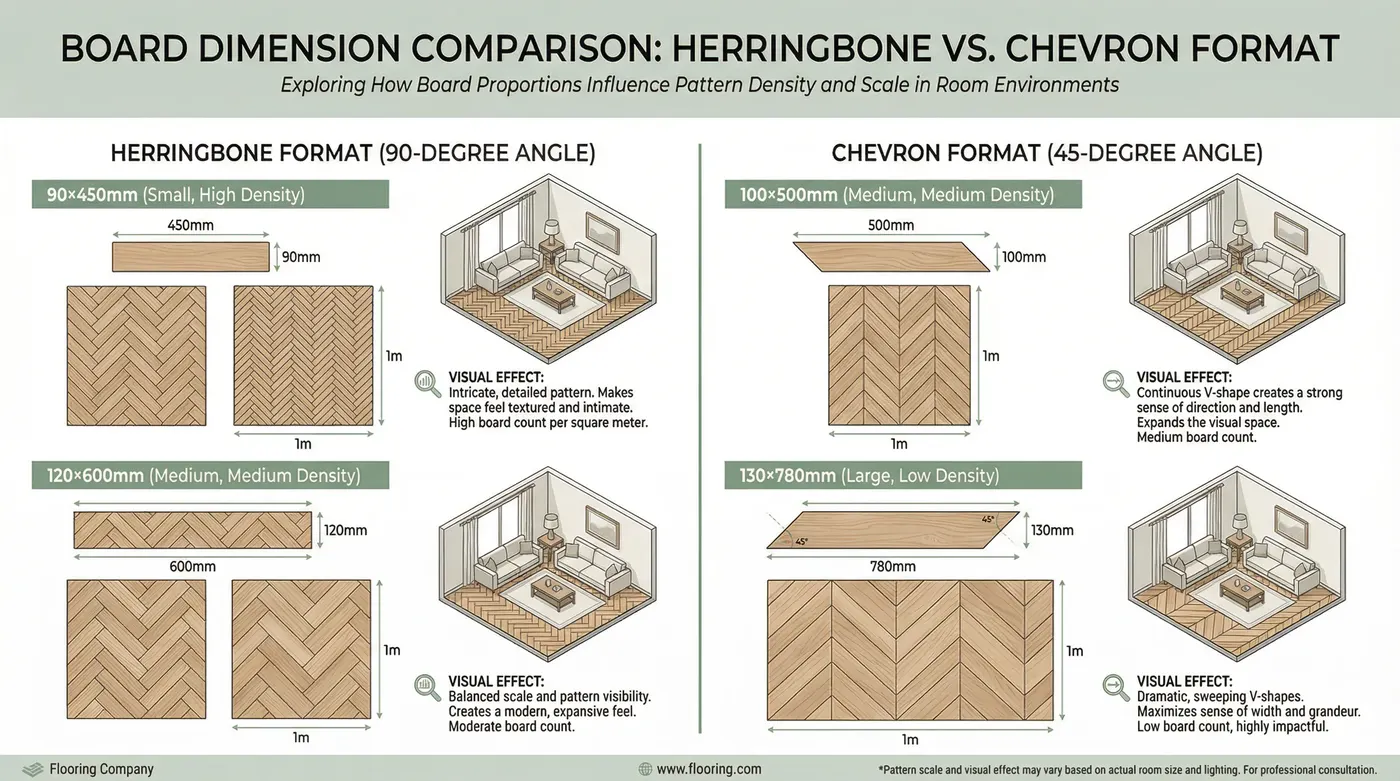
The standard format for herringbone is boards in the range of 90mm to 130mm in width, with lengths typically running at a 3:1 or 4:1 ratio (a 90mm-wide board might be 360mm or 450mm long; a 130mm board might be 520mm long). This proportion is geometrically essential: boards that are too wide relative to their length produce a pattern that reads as blocky and unresolved; boards that are too long relative to their width produce a pattern that loses its textural character and begins to look like an elongated straight-lay floor interrupted by occasional breaks.
For the Melbourne market, the most frequently specified herringbone format is 120mm × 600mm — which sits comfortably within the proportional range that the pattern requires.
For Chevron
Chevron boards typically follow a similar proportional logic but with one critical difference: the mitre-cut ends reduce the usable length of each board, so longer boards are generally preferred to prevent the finished pattern from appearing too fine-pitched. Typical chevron formats range from 100mm × 500mm to 130mm × 780mm. The 45-degree cut removes a triangular section from each end; a board that is 600mm long in the blank will yield approximately 500mm of usable, visible length after cutting to the correct angle.
The wider and longer the board, the bolder and more graphic the V — an important calibration when matching the pattern scale to the room dimensions.
Installation Complexity and Cost Premium
Both patterns represent a significant step up in installation complexity compared to straight-plank laying. Chevron is the more demanding of the two, and the cost differential should be factored into any budget.
Herringbone Installation
Herringbone requires a skilled installer working to a precise layout grid established before a single board is fixed. The work begins at the centre of the room — not the wall — and proceeds outward. Accuracy in the initial layout is non-negotiable: an error of even a few millimetres in the starting geometry compounds across the floor and will be visible to the trained eye in the finished result.
Material wastage runs at approximately double straight-lay installation, accounting for the cut pieces at borders and the careful fitting required at architectural interruptions — doorways, hearths, built-in cabinetry bases. The labour premium over straight plank is typically an additional 50%, reflecting the skill, time, and precision involved.
Chevron Installation
Chevron carries everything herringbone demands, plus the added complexity of the precision mitre cut at each board end. The angle must be consistent to within fractions of a degree across every board in the floor; any variation accumulates in the tip-to-tip joints and produces a visible irregularity that undermines the pattern’s defining characteristic — its geometric purity.
For this reason, chevron is best specified with factory pre-cut boards rather than site-cut boards, as the precision of a factory mitre saw is difficult to replicate on-site consistently across thousands of cuts. Material wastage runs at double — reflecting the triangular cut-off at each end — and the labour premium over straight plank typically runs at around 50% extra than straight lay planks.
The investment is not trivial, but it reflects a result that cannot be achieved any other way: a floor that delivers the precise, unbroken geometry that defines chevron at its best.
Grade Selection: Less Is More with Pattern Floors
This is one of the most consequential and most frequently overlooked decisions in a patterned floor specification.
Timber grade affects how much natural character — knots, gum veins, colour variation — appears in the finished floor. In a straight-plank floor, natural grade variation works with the laying pattern rather than against it. In a herringbone or chevron floor, the relationship between grade and pattern is more complex.
Both herringbone and chevron are visually complex patterns in their own right. They generate substantial visual interest through geometry alone. When a highly characterful grade — Natural or Feature — is added to an already complex geometric pattern, the two sources of visual information compete for attention. The result can feel restless and fatiguing rather than rich and interesting.
The reliable principle for patterned floors:
Prime or Select Grade allows the geometry to dominate. The quieter the timber surface, the more legible and refined the pattern. This is the correct choice for a contemporary interior where the pattern is the design statement.
Natural Grade can work in herringbone if the species is naturally calm in character (European Oak is the best example), but should be approached carefully.
Feature Grade — with its large knots, prominent gum veins, and dramatic colour shifts — actively competes with a geometric pattern and is generally not recommended for either herringbone or chevron installations. The exception might be a deliberate maximalist interior where the intention is deliberate visual complexity, but this requires very careful editorial control over the overall scheme.
European Oak in Prime or Select Grade remains the reference specification for both patterns in the premium Australian market, and for good reason: its fine, consistent grain structure and warm, neutral colour palette provide the ideal background against which geometric patterns can read with full clarity.
Room Size and Pattern Choice
The scale of the room interacts with pattern choice in ways that are counterintuitive but important.
Small rooms (under approximately 20 square metres) are generally better served by chevron than herringbone. Herringbone’s textural busyness can make small rooms feel enclosed and dense. Chevron’s directional energy — particularly when the V points toward the room’s primary axis of view — creates a sense of visual depth that reads as spatially generous.
Large rooms (open-plan zones over 50 square metres) can absorb either pattern, but herringbone at scale is particularly spectacular. The rich, textural quality that can feel overwhelming in a small space becomes genuinely sumptuous when given room to breathe across a generous floor area.
Narrow rooms (corridors, entrance halls) are where chevron truly excels. Laid with the V pointing away from the entry toward the rear of the space, chevron in a corridor creates a powerful perspective effect, visually elongating the space and drawing the occupant forward.
Directional Tricks: Chevron as a Spatial Tool
Chevron’s directional properties deserve their own section, because they represent a genuinely useful design tool that straight-plank laying cannot replicate.
When the V-apex of a chevron floor points toward the far end of a room, the eye follows the converging angles toward that focal point. The psychological effect is of a room that is longer and deeper than its actual dimensions. In a narrow entrance hall, this transformation can be dramatic: a hallway that would feel tunnel-like with a straight lay becomes a considered, intentional architectural procession under chevron.
The same logic applies in reverse: a wide, shallow room that lacks depth can be given visual extension by running the chevron axis along its depth rather than its width.
The apex direction should be established as part of the design brief, not left to the installer’s discretion. It is one of the small decisions with the largest spatial consequences.
Pairing Patterns with Interior Styles
Herringbone: The Heritage and Transitional Choice
Herringbone is a pattern with five centuries of interior architecture behind it, and it wears that history visibly. It belongs naturally in:
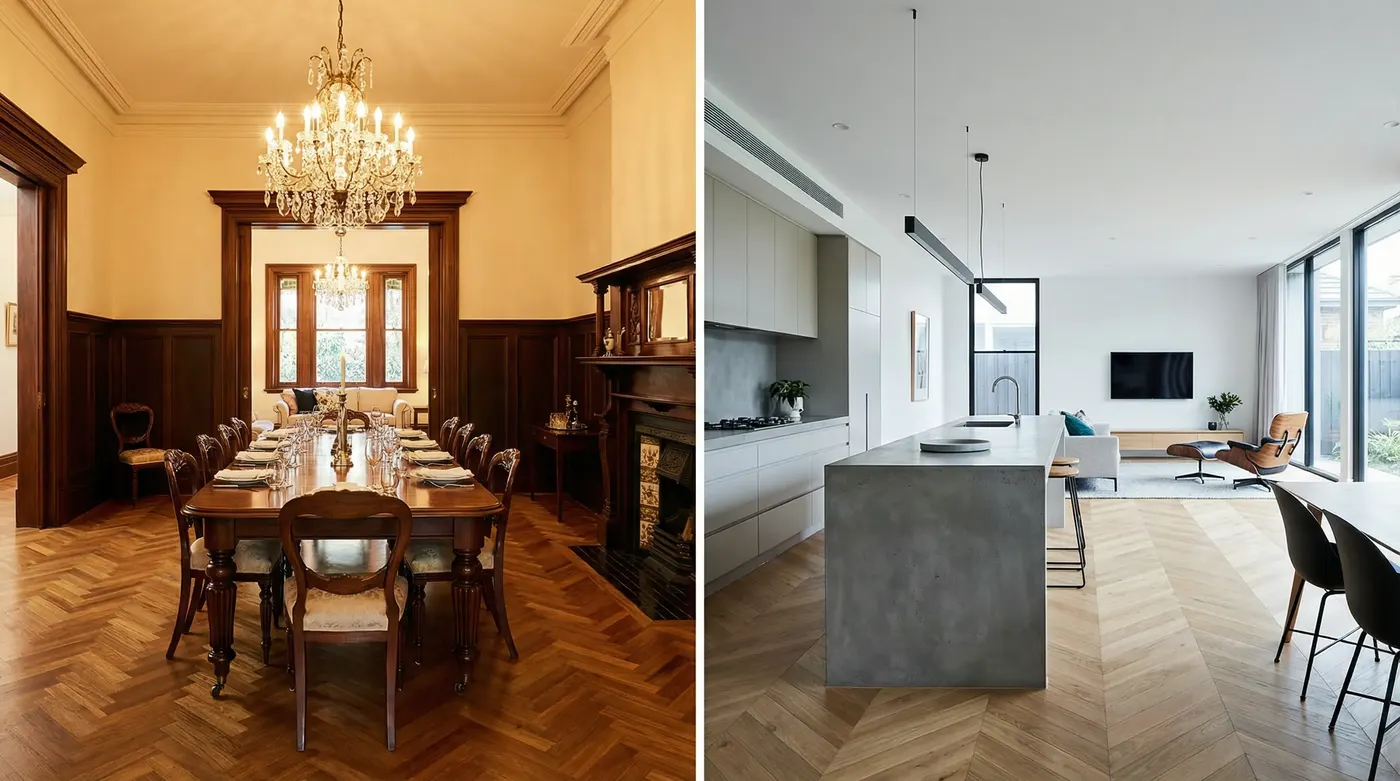
- Heritage and period homes — Victorian and Edwardian properties in Melbourne’s inner suburbs, where the pattern’s historical pedigree reinforces the architectural character of the building
- Transitional interiors — homes that balance contemporary finishes with classic references, where herringbone provides the classical anchor against which modern cabinetry and fittings can play
- Formal rooms — dining rooms, studies, libraries, formal sitting rooms, where the pattern’s visual weight creates the sense of occasion appropriate to the space
- Restoration projects — where a herringbone floor echoes the parquetry traditions of the original building’s era
It is less suited to minimalist contemporary interiors, where its visual complexity can disrupt the calm that the design is working to achieve.
Chevron: The Modern and Contemporary Choice
Chevron carries a lighter historical load and reads more comfortably in:
- Contemporary and modernist interiors — particularly those with clean-lined cabinetry, monochromatic palettes, and deliberate spatial control
- New build apartments and townhouses — where the architect is working with clean geometries and the pattern reinforces rather than competes with the architectural language
- Open-plan living and dining zones — where the directional energy of the V creates movement and interest across a large surface without the visual density of herringbone
- Entrance halls and corridors — where the elongating effect of the pattern does specific spatial work
EN 13489 and Multi-Layer Parquet: What the Standard Tells You
When specifying engineered parquetry boards for herringbone or chevron installations, EN 13489:2023 — the European standard governing multi-layer parquet elements — is the relevant technical reference.
EN 13489 defines the construction requirements for engineered timber flooring with a veneer face layer and a multi-layer core (typically cross-laminated), covering dimensional tolerances, moisture content thresholds, delamination resistance, and wear layer specifications. For herringbone and chevron applications, the dimensional tolerance requirements of EN 13489 are particularly significant: the precision of the pattern depends on boards that are manufactured to tight length, width, and squareness tolerances. A batch with excessive dimensional variation will produce visible irregularities in the finished pattern, regardless of installer skill.
The Final Choice
If the question is simply which is more beautiful? — the honest answer is that neither has a claim over the other. Both are extraordinary when well executed, in the right space, with the right species and grade, and at the right scale.
If the question is which belongs in your specific project? — the answer lies in understanding what the room needs from its floor. Richness, warmth, and historical depth: herringbone. Direction, movement, and contemporary elegance: chevron. In a home with enough rooms, you might do both.
What matters is the decision is made as a design decision — considered, purposeful, and specific to the space — rather than as a default. Both patterns reward that level of intention, and both will still be looking magnificent in forty years.
Published by The Flooring Centre — Melbourne's premium carpet and flooring superstores. Visit our Nunawading and Hawthorn showrooms.