By The Flooring Centre Technical Team
Sustainability has become one of the most used — and most abused — words in the flooring industry. Walk through any flooring showroom or browse any manufacturer’s website and you will encounter a cascade of green credentials: recycled content, carbon neutral, natural fibres, eco-certified, low-emission, planet-friendly. Some of these claims are substantive and verifiable. Many are vague. Some are misleading in ways that are difficult to detect without technical knowledge.
This article is not a celebration of the flooring industry’s sustainability credentials. It is a technical framework for evaluating those claims with scepticism and rigour — one that gives you the tools to distinguish genuine environmental performance from marketing vocabulary that has been positioned to make you feel good without actually telling you anything.
Sustainability in flooring is not a single dimension. It encompasses raw material sourcing, manufacturing processes, transport emissions, indoor air quality, lifespan, and what happens to the floor at the end of its useful life. A product that excels on one dimension while performing poorly on another deserves qualified assessment, not a green badge. The following sections examine each dimension with the level of precision it warrants.
What Sustainability Actually Means in Flooring: A Framework
Before evaluating specific products, it is worth establishing the framework through which a genuinely sustainable flooring choice should be assessed. Lifecycle assessment (LCA) — the methodology used by environmental scientists and product designers to quantify the total environmental impact of a product from raw material extraction through manufacturing, transport, use, and end-of-life — is the correct lens.
The five dimensions of a flooring LCA:
- Raw material sourcing: Is the primary material renewable? Is its extraction managed in a way that preserves the ecosystem from which it comes?
- Manufacturing: What energy, water, and chemical inputs are required to convert the raw material into a finished product? What waste streams are generated?
- Transport: What is the carbon footprint of shipping the product from its point of manufacture to its point of installation?
- In-use phase: How does the product affect indoor air quality during its life? How long does it last? Does it require replacement more frequently than alternatives?
- End-of-life: Can the product be recycled, composted, or reclaimed? Or does it go to landfill?
A product that performs well on raw material sourcing but requires energy-intensive manufacturing, arrives by air freight from across the world, lasts only eight years, and ends up in a landfill is not a sustainable product — even if its marketing leads entirely with the sourcing story.
Timber: A Global Certification System
Timber is the flooring category where certification frameworks are most mature and most meaningful.
FSC Certification
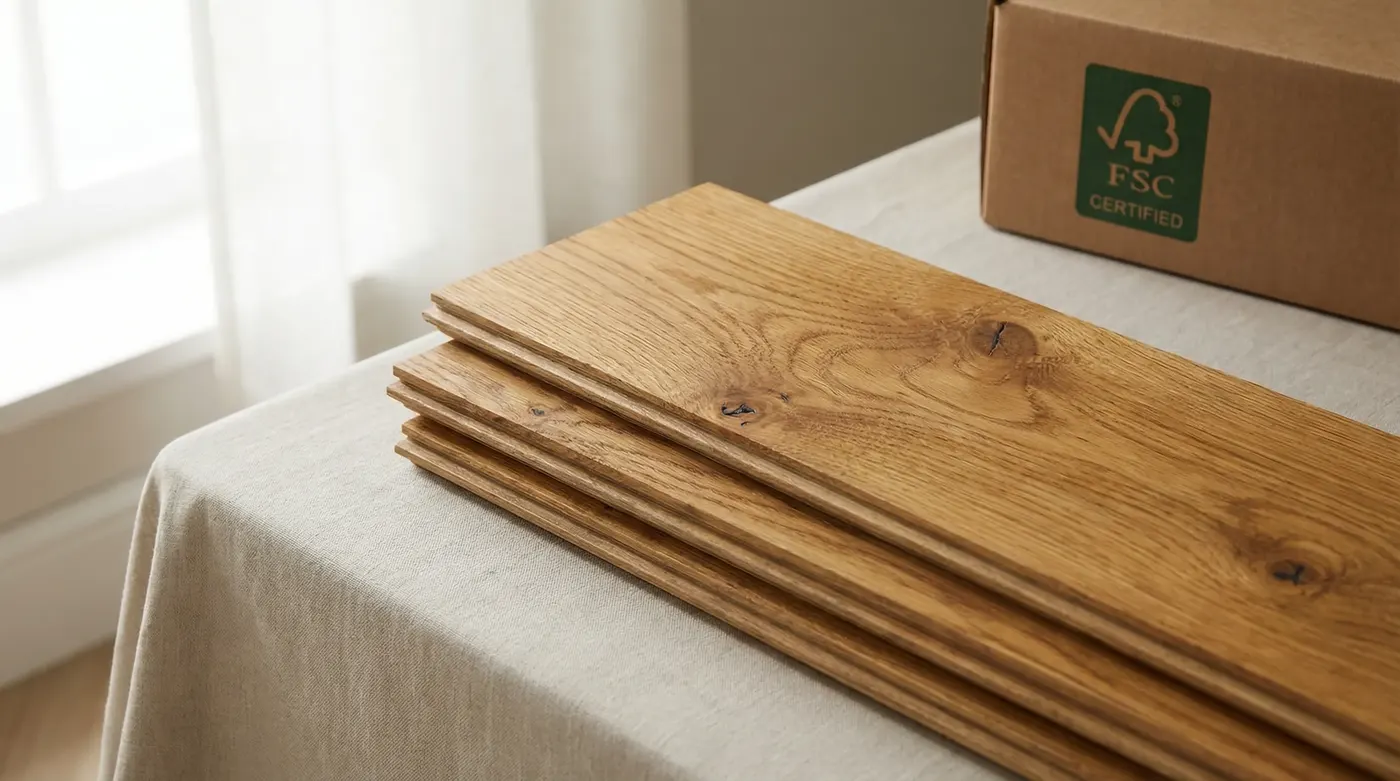
The Forest Stewardship Council (FSC) is the gold standard for responsible forest management certification. FSC certification means that the timber has been sourced from a forest managed according to strict environmental, social, and economic criteria: biodiversity conservation, protection of indigenous rights, prohibition of old-growth conversion, and ongoing independent auditing. The scheme operates on a Chain of Custody (CoC) basis — every step in the supply chain from forest to finished product is certified, meaning that FSC-labelled flooring at point of sale has been tracked continuously from the certified forest.
PEFC Certification
The Programme for the Endorsement of Forest Certification (PEFC) is the FSC’s counterpart and near-equivalent — a global framework that endorses national forest certification systems. In Europe, where much of Australia’s premium engineered oak originates, PEFC certification covers the majority of managed private forests in France, Germany, and the Nordic countries. European Oak from PEFC-certified French forests carries meaningful environmental assurance about its sourcing, even though it is less well-known to Australian consumers than the FSC label.
FSC or PEFC are often requested by Architects in commercial developments. Compliance with these programs though does come at a cost and products that have these certifications are generally priced accordingly.
Responsibly sourced hardwood can exist without being certified where the manufacturer deems price sensitivity to warrant non-inclusion in the certification processes and for many domestic installations, this is suitable.
Engineered Timber: Efficiency as a Sustainability Argument
One of the least discussed but most compelling sustainability arguments for engineered hardwood over solid timber is one of simple resource efficiency.
A solid timber floor board is sawn directly from the log. The usable thickness is the full board thickness — typically 18mm to 21mm. Much of the log’s cross-section is consumed in producing each board, and the sawdust, offcuts, and dimensional irregularities in the log represent waste that cannot be recovered.
An engineered timber board uses the same premium hardwood species — European Oak, Blackbutt, Spotted Gum — as its face veneer, typically at a thickness of 3mm to 6mm. The structural work of the board is done by the core material, which in quality engineered products is a cross-laminated hardwood core — typically Hevea Brasiliensis from plantation-grown Indonesian rubber trees, or a multiply core made with Eucalyptus for example.
The efficiency implication: a single log of premium European Oak can yield four to six times the floor coverage as engineered boards compared to solid boards. The premium species is used exactly where its visual and tactile qualities are expressed — at the surface — while a sustainable, purpose-grown core material does the structural job beneath it. This is lifecycle material efficiency that LCA methodology recognises as a genuine environmental advantage.
Hevea Brasiliensis: The Sustainable Core Material
Hevea Brasiliensis — the rubber tree — deserves specific attention as an engineered flooring core material. Rubber trees are plantation-grown across Indonesia, Malaysia, and surrounding regions, primarily for latex production. When a rubber tree’s latex productivity declines (typically after 25–30 years), the tree is harvested for timber and replaced by new seedlings — a second-life use of a timber crop that would otherwise be waste.
The Hevea Brasiliensis used in engineered flooring cores is therefore a secondary-use plantation timber rather than a primary timber crop: it occupies no additional land, requires no additional clearing, and represents the recovery of value from a material that would otherwise be burned or discarded. Its density and hardness — comparable to White Oak — make it technically excellent as a structural core. Its sustainability story is genuinely strong.
Wool Carpet: The Renewable Fibre Argument
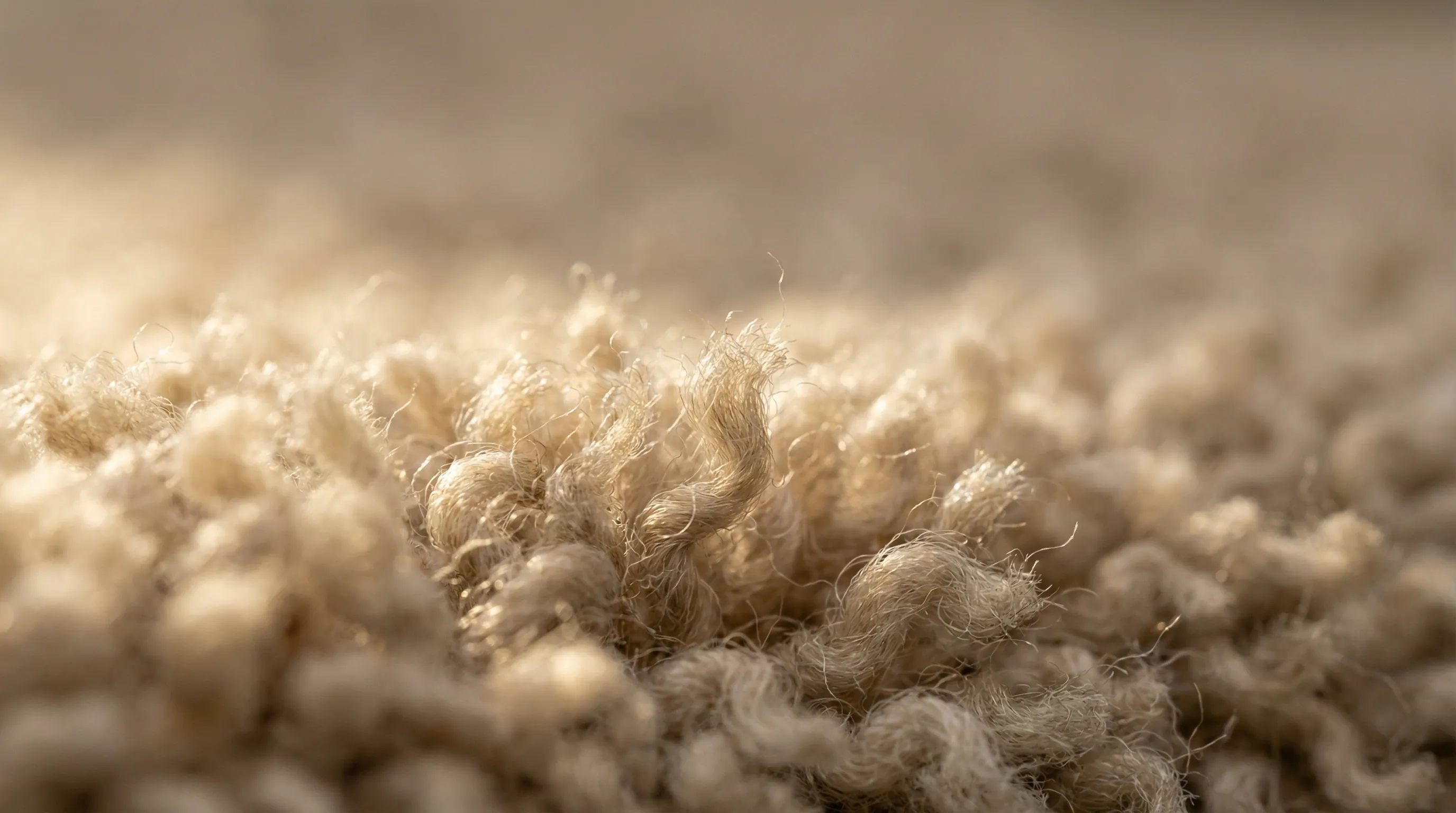
Wool is the only major carpet fibre that is both renewable and biodegradable — a combination that is exceptional in the synthetic-dominated flooring market.
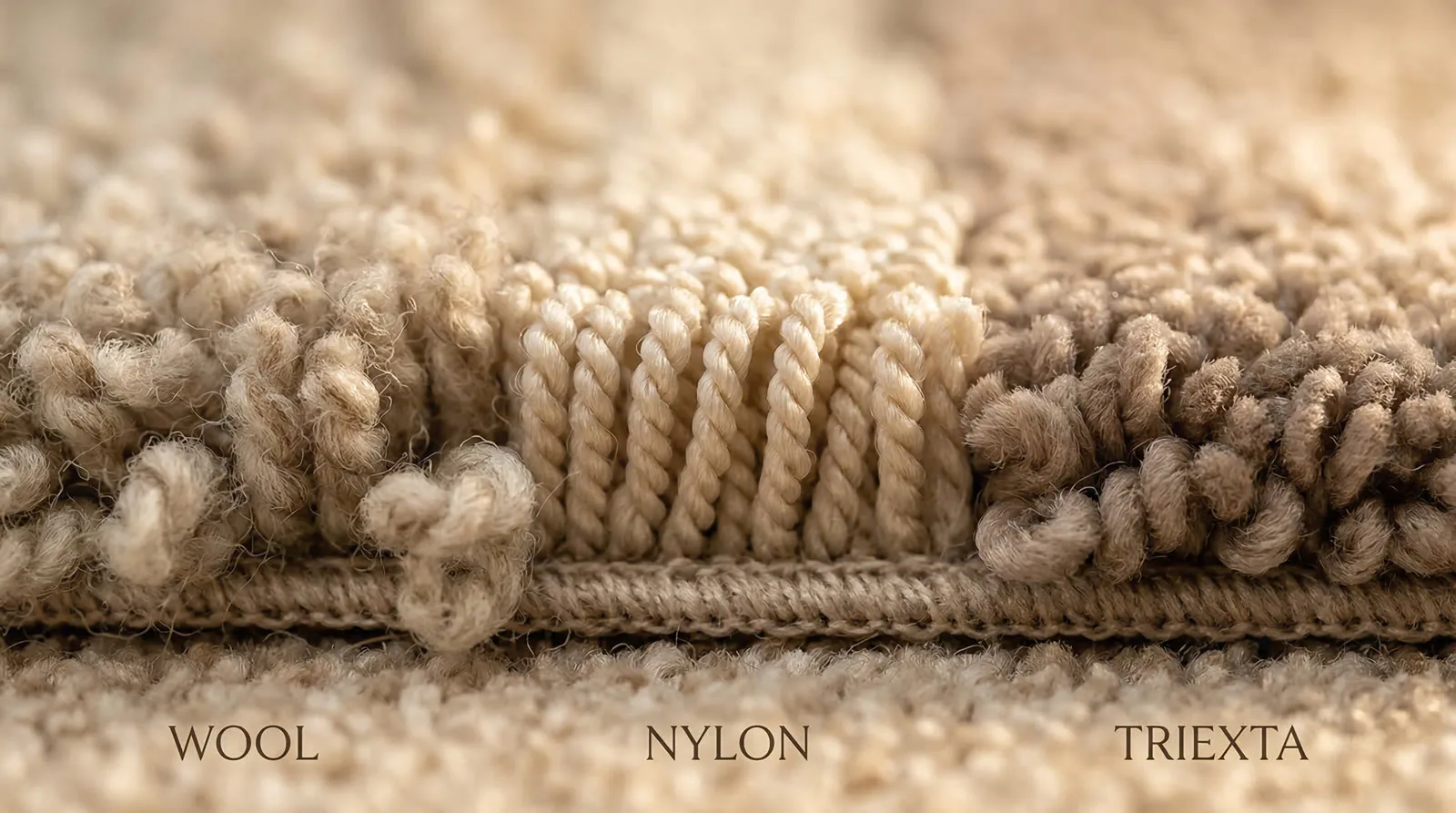
Wool grows continuously on the sheep’s back, requiring nothing more than grass, water, and the animal’s metabolic energy. A well-managed sheep station is a model of circular resource use: the land produces the grass, the sheep produces the wool, the wool is shorn, the sheep grows more. Unlike polyester and nylon, which are synthesised from petrochemical feedstocks using energy-intensive processes — wool’s manufacturing process begins not in a chemical plant but on a working farm. Triexta uses around 12% less energy to produce thanks to its 37% natural content. Some nylon and polyester carpets are made using recycled content, however the cost of energy to recycle these post-consumer materials into usable first grade yarn is something that should be factored into the green equation.
Carbon Sequestration in Wool
Wool’s sustainability story includes a dimension that is rarely communicated but is scientifically verifiable: wool sequesters atmospheric carbon during its growth. Approximately 50% of the dry weight of wool fibre is carbon — carbon that was drawn from the atmosphere as carbon dioxide during the growth of the grass the sheep consumed. When wool goes into a floor and is walked on for twenty years, that carbon remains sequestered in the fibre for the duration of its useful life. This is not a theoretical benefit; it is a measurable carbon storage function.
At end of life, wool biodegrades in soil conditions in as little as three to five years, releasing its stored carbon back into the soil as organic matter rather than into the atmosphere as combustion CO₂ — the outcome for petrochemical fibres disposed of in landfill.
Wool’s Limitations
Intellectual honesty about wool requires acknowledging its limitations. Wool requires significantly more land and water per kilogram of fibre than synthetic alternatives. Sheep farming in certain configurations generates methane emissions. These factors are real and should be factored into any holistic assessment. The measured environmental case for wool remains positive compared to synthetics in most LCA frameworks — but it is not without complexity, and the claim that wool is inherently “the sustainable choice” oversimplifies a nuanced picture.
VOC Emissions: E0, E1, and GREENGUARD Certification
Indoor air quality is one of the most directly consequential environmental attributes of a flooring product — it affects not a distant ecosystem but the air breathed by the occupants of the building every day.
The primary concern is volatile organic compound (VOC) emissions: chemical compounds released from adhesives, finishes, and composite materials that evaporate into the indoor air environment. Formaldehyde — a Group 1 carcinogen — is the most significant and most regulated of these, particularly in timber composite products where urea-formaldehyde resins have historically been used as binders.
Formaldehyde Classifications: E0 and E1
The European classification system provides the most widely used reference framework for formaldehyde emissions from wood-based panels and flooring:
- E1: Maximum formaldehyde emission of 0.1 ppm (0.1 mg per cubic metre of air). This is the standard European baseline requirement and the minimum that should be accepted in a residential installation.
- E0: Maximum formaldehyde emission of 0.05 ppm — half the E1 threshold. E0 represents a meaningfully lower-emission specification and should be the stated standard for any engineered flooring in bedrooms, children’s rooms, or any space where prolonged occupancy occurs.
GREENGUARD Certification
GREENGUARD (now part of UL) is a third-party certification scheme that tests and certifies products for chemical emissions, including formaldehyde, acetaldehyde, and a wide range of other VOCs. GREENGUARD Gold certification (previously GREENGUARD Children & Schools) applies the most stringent emission limits — calibrated to the sensitivity of children in school environments — and represents the highest emission assurance available from a third-party certifier.
For any flooring specified in children’s bedrooms, family rooms, or spaces with vulnerable occupants, GREENGUARD Gold certification is the appropriate benchmark to specify.
The CIAL Environmental Certification Scheme
The Carpet Institute of Australia Limited (CIAL) operates an Environmental Certification Scheme that evaluates carpet products across several sustainability dimensions:
- VOC emissions: Total VOC and formaldehyde emissions from the finished carpet, measured under controlled conditions
- Thermal resistance (R-value): Carpet’s insulation contribution, which reduces heating and cooling energy requirements
- Noise reduction: Carpet’s contribution to acoustic absorption, reducing the energy cost of noise management in residential and commercial spaces
- Recyclability: Whether the carpet and its backing can be returned for recycling at end of life
The CIAL environmental certification is a useful baseline reference for any carpet purchase in the Australian market, providing independent verification of claimed environmental attributes. It should be considered in conjunction with fibre certification (FSC or similar for natural fibres) and the Australian Carpet Classification Scheme (ACCS) star rating for performance durability — a carpet that wears out in five years and goes to landfill is not sustainable, regardless of its fibre content.
Solution-Dyed Manufacturing: A Quiet Revolution in Sustainability
The dyeing of synthetic carpet fibres is one of the most water-intensive steps in the manufacturing process. In traditional beck dyeing (also called solution dyeing after the fact, though the term is sometimes confused) — where finished yarn or carpet is immersed in dye baths — the process consumes thousands of litres of water per kilogram of fibre, generates heavily coloured wastewater requiring treatment, and uses energy to heat the dye baths to the temperatures required for colour fixation.
Solution dyeing — also called dope dyeing or spin dyeing — is fundamentally different. Rather than dyeing the fibre after it has been spun and formed, the colouring pigment is introduced into the polymer melt before the fibre is extruded. The colour becomes an integral part of the fibre’s molecular structure rather than a surface coating.
The environmental and performance advantages are substantial:
- Near-zero wastewater: No dye bath, no coloured effluent requiring treatment
- Dramatically reduced water consumption: Typically 70–80% less water per kilogram of fibre compared to conventional dyeing
- Superior colour fastness: Because the pigment is locked into the fibre structure rather than applied to the surface, solution-dyed fibres resist fading from UV exposure, cleaning chemicals, and abrasion far more effectively than conventionally dyed alternatives
- Reduced energy consumption: No heating of large dye baths
Solution-dyed nylon and solution-dyed polyester/PET are now mainstream in the carpet industry, and their sustainability credentials at the manufacturing stage are genuine and measurable. When evaluating a carpet product, the question “is this solution-dyed?” is worth asking — not only for environmental reasons but for performance ones.
Recycled Content: Backing, Underlay, and the Secondary Materials Stream
Beyond the primary fibre, a carpet system comprises backing materials and underlay — and this is where recycled content makes its most substantive contribution in the current market.
Carpet Backing
Many carpet manufacturers now incorporate recycled PET (polyethylene terephthalate — the same polymer used in plastic bottles) in primary and secondary carpet backings. Recycled PET for carpet backing diverts post-consumer plastic from landfill and reduces the demand for virgin petrochemical feedstock. Where a manufacturer can provide documentation of the percentage of recycled content in the backing and the chain of custody of that recycled material, this is a meaningful sustainability credential.
Underlay
Premium carpet underlay products in the Australian market frequently incorporate recycled content — typically from end-of-life foam products, which represent one of the most challenging waste streams in circular economy terms. Recycled foam underlay provides excellent acoustic and thermal performance while recovering value from a material that would otherwise require disposal.
Some premium underlay brands are lauded for their approach to environmental safeguarding because they divert brand new foam from furniture production and use it for underlay manufacturing. /* PURELAY POSTPONED - REINSTATE MAY 2026: Original text referenced PureLay by name */ This not only re-purposes what would otherwise become waste, but the premium quality of the foam (as it has not been used before) is such that one day when it does need to be recycled, it can deliver higher value outcomes for the recycler as it hasn’t been down cycled before.
When specifying carpet for a sustainable project, the sustainability of the full system — fibre, backing, underlay, and adhesive or fixing system — should be assessed. Focusing only on fibre content while ignoring the other 40% of the carpet system is a partial analysis.
Lifespan: The Most Underrated Sustainability Variable
This is the dimension of flooring sustainability that most people fail to consider, and it is arguably the most important of all.
Consider two floors:
Floor A: A premium hardwood floor installed in 1980 in a South Yarra terrace, sanded and refinished a couple times over 40 years, currently in excellent condition and projected to last many more with normal maintenance. Total lifecycle: 50+ years.
Floor B: A budget hybrid floor, replaced after 5 years due to joint damage and wear, replaced again after a further 5 years, now being replaced for the third time — total material consumed over 15 years: three entire floors!
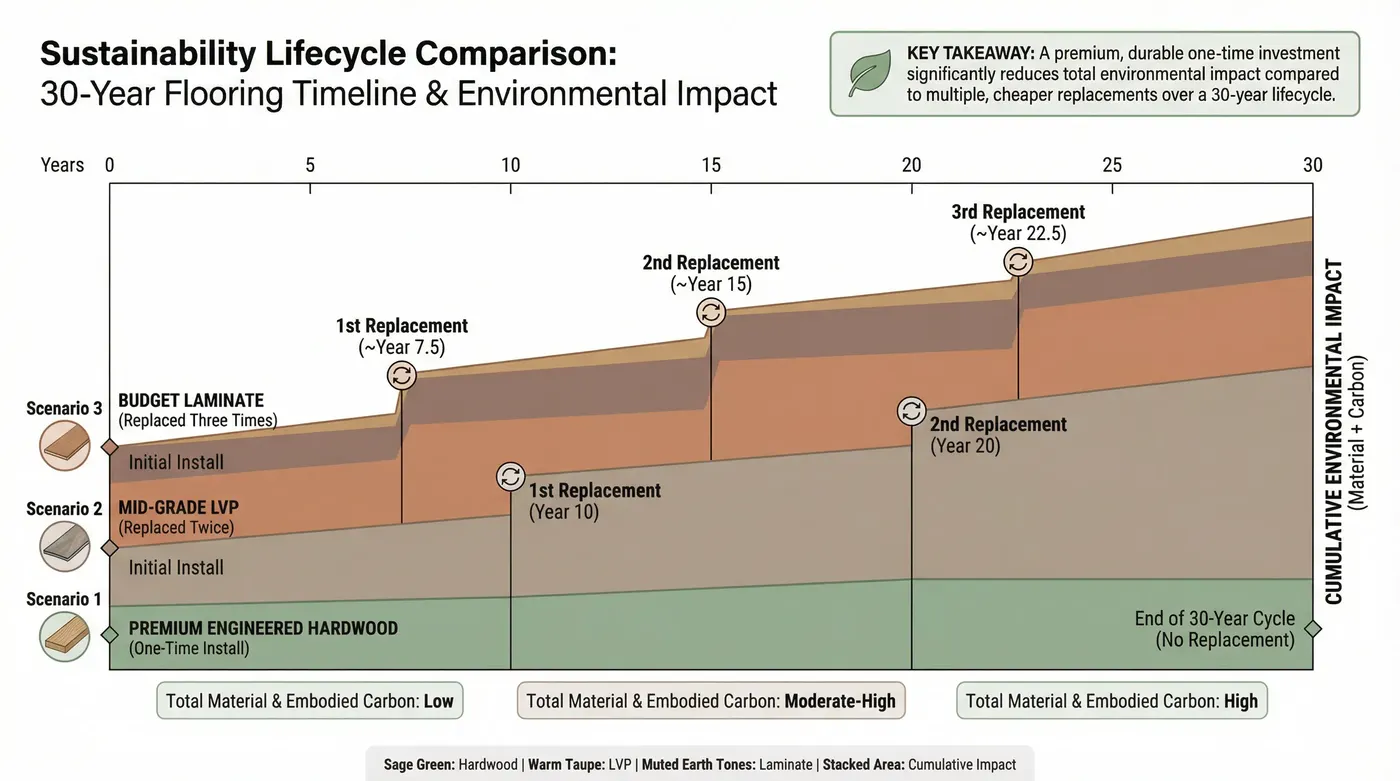
Floor B may have been manufactured from recyclable content (which most aren’t), may carry an environmental certification, and may have cost significantly less per square metre. But across its actual lifecycle, it has consumed three times the raw materials, three times the manufacturing energy, and generated three times the landfill waste of a single premium hardwood installation.
Durability is sustainability. A premium hardwood floor that lasts 50 years without replacement — amortising its initial carbon investment over five decades — will outperform almost any competing material on a lifecycle basis. The initial cost premium of a high-quality floor, when evaluated against its total lifecycle, frequently represents the most economically and environmentally rational choice.
Imported Products: The Transport Carbon Equation
Carbon emissions from transport are a legitimate sustainability consideration, but they require proportional assessment.
European Oak engineered flooring, manufactured overseas and shipped to Australia by sea freight, has a transport carbon footprint that is real but comparatively modest in the context of its total lifecycle emissions. Sea freight is the most energy-efficient mode of freight transport per tonne-kilometre, and the carbon cost of a container of flooring shipped from Europe or Asia to Melbourne — amortised over the 50-year life of the installed floor — is a small fraction of the product’s total environmental profile. Due to years of off-shoring our manufacturing capabilities, Australia doesn’t produce hardwood, laminate or hybrid flooring in any serious volume and nearly all of the choices available will be imported. However, the great news is the Australian carpet industry is still vibrant and strong and the vast majority of carpets in Australia are made right here in Victoria!
What Greenwashing Looks Like in Flooring: Red Flags
The flooring industry, like most consumer product categories, has responded to consumer demand for sustainability by producing sustainability language at a rate that outpaces the actual environmental improvements behind it. Here is what to look for — and be sceptical of.
“Natural product” — Almost meaningless. Stone is natural. So is asbestos. The naturalness of a raw material tells you nothing about the sustainability of its extraction, processing, or end-of-life management.
“Eco-friendly formula” — Without specifying what makes it eco-friendly, compared to what baseline, measured by whom, and verified by which third party, this is marketing vocabulary, not a technical claim.
“Carbon neutral” — This claim requires scrutiny. Carbon neutrality can be achieved through genuine emission reduction, through verified carbon offset purchases, or — less rigorously — through offsets that have not been subject to independent verification. Ask for the carbon neutral certification body and the vintage year of the offsets. A product that claims carbon neutrality based on expired or unverified offsets is making a misleading claim.
“Recycled content” — Ask: what percentage? Of which component? Pre-consumer waste (manufacturing offcuts recycled back into the same process) or post-consumer waste (material recovered from the end-of-life stream)? Post-consumer recycled content is considerably more meaningful from a waste diversion standpoint, but rarely used in flooring as it is unreliable and inconsistent.
“Low VOC” — Lower than what? The absence of a reference baseline makes this claim unverifiable. The correct specification language is “E1 formaldehyde classification” or “GREENGUARD Gold certified” — specific, independently verified, and comparable across products.
“Sustainably sourced timber” — Unless accompanied by a named certification scheme (FSC, PEFC) with a verifiable chain-of-custody certificate number, this is an unverified assertion. It is worth re-iterating though that Hevea Brasiliensis — the rubber tree core used in some premium engineered flooring — deserves specific attention on this subject as it doesn’t come with a certification as it doesn’t need one! Rubber trees are plantation-grown across Indonesia, Malaysia, and surrounding regions, primarily for latex production. When a rubber tree’s latex productivity declines, the tree is harvested for timber and replaced by new seedlings — a second-life use of a timber crop that would otherwise be waste.
Sustainable flooring is not a category — it is a practice. It requires the same rigorous, evidence-based evaluation that any other significant purchase warrants. The tools to make that evaluation exist. The standards, certifications, and lifecycle frameworks described in this article give you the technical vocabulary to use them.
Published by The Flooring Centre — Melbourne's premium carpet and flooring superstores. Visit our Nunawading and Hawthorn showrooms.