By The Flooring Centre Technical Team
Every interior design decision begins, whether the client knows it or not, at the floor. The floor is not a neutral element, a default, or a background condition. It is the largest continuous horizontal surface in the home, the element the eye registers first when entering any room, and the anchor against which every wall colour, joinery selection, and furniture specification is calibrated. Get the floor right, and the rest of the room has a foundation to build from. Get it wrong, and no amount of expensive furniture or curated accessories will correct the underlying discord.
Colour is the dimension of floor selection most clients feel equipped to navigate, and yet it is the one most likely to produce regret. The timber plank or carpet sample that looked perfect in the showroom reads differently on 40 square metres of living room floor, in a room with specific orientation, window configuration, and fixed cabinetry that the showroom did not replicate. Colour selection done well requires method, not intuition.
This article provides that method.
The Floor as the Anchoring Element: Understanding the 60-30-10 Rule
Before examining specific colour decisions, it is worth establishing the design principle that makes floor colour so consequential: the 60-30-10 colour rule, a compositional framework used in professional interior design that describes the ideal weight distribution of a colour palette within a room.
The framework allocates:
- 60% of the room’s visual field to the dominant colour — typically walls, large upholstered pieces, and floor
- 30% to a secondary colour — typically cabinetry, curtains, and smaller furniture
- 10% to an accent colour — cushions, artwork, hardware, decorative objects
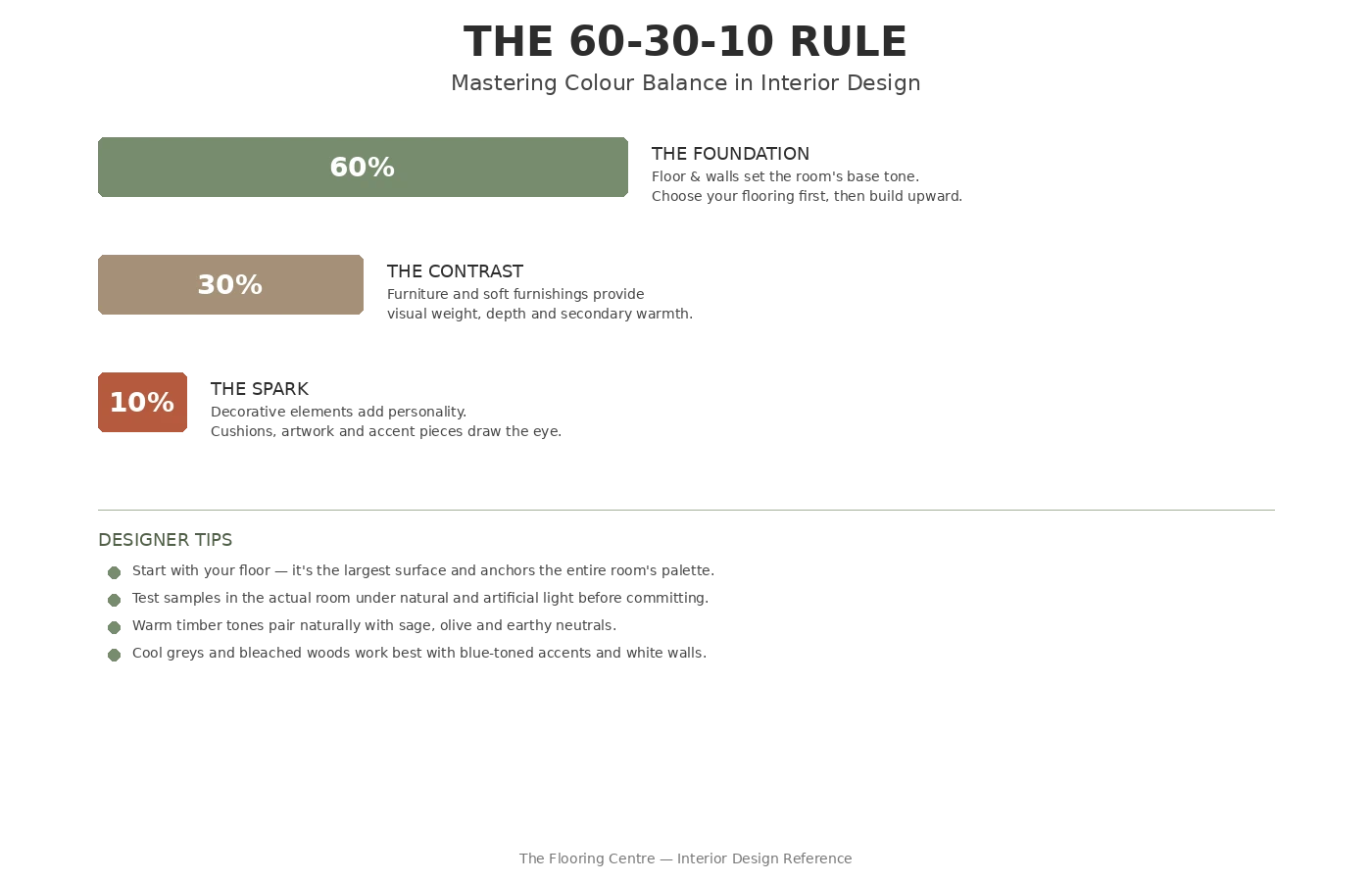
In most residential spaces, the floor accounts for a material proportion of the 60% dominant zone. Its colour does not merely complement the room — it constitutes the room’s foundational tone. A floor that reads as cool grey in isolation reads as cool grey across the entire base of the space, subtly cooling every material above it. A warm honey oak reads warmth throughout.
The Light Spectrum: From Blonde to Espresso
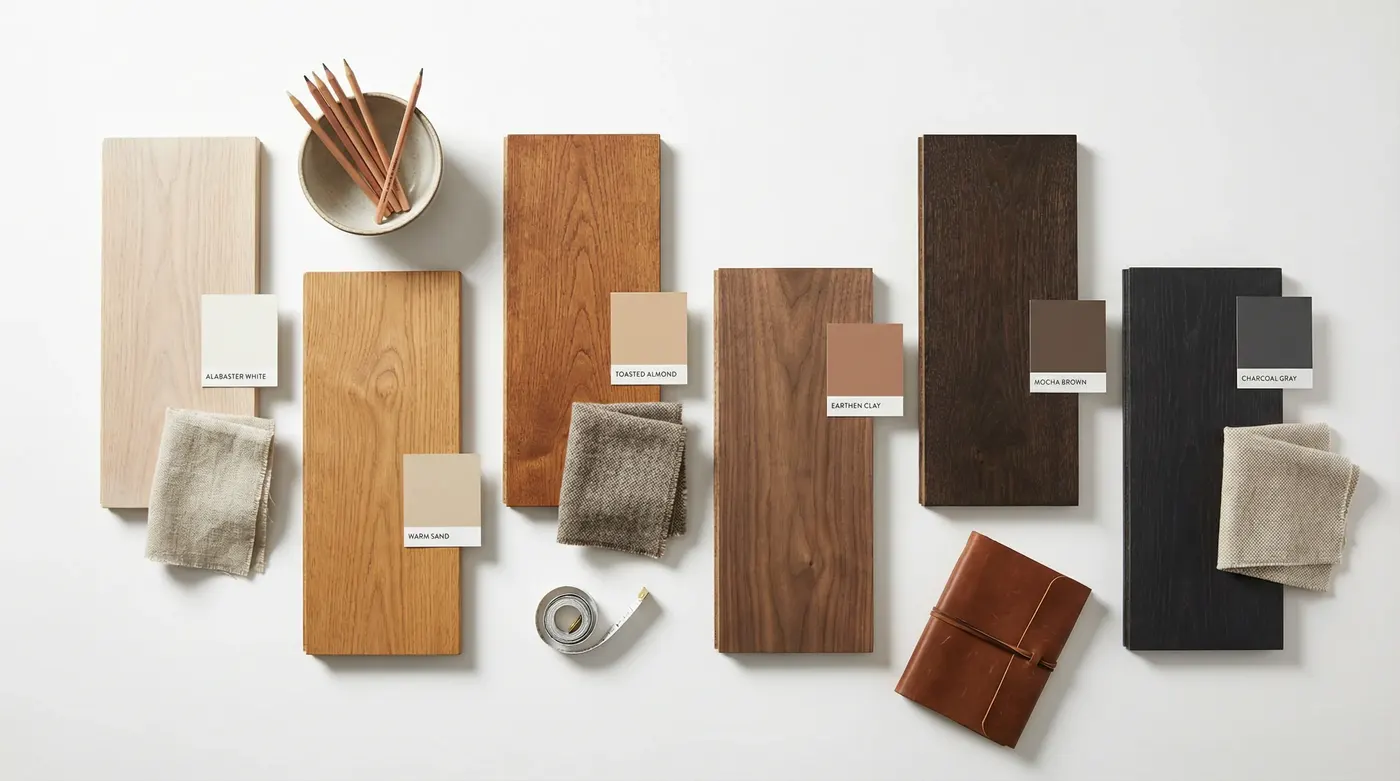
Timber and timber-look flooring — whether solid hardwood, engineered, water resistant laminate, or hybrid/luxury vinyl — presents in a continuous spectrum from lightest to darkest. Understanding where each tone sits and how it behaves in a space is the first step to accurate selection.
Blonde and Whitewashed Tones
At the lightest end of the spectrum sit bleached, whitewashed, and pale-blonde floor tones. European oak in a white or light French oil finish, or blonde-washed hybrid boards, falls here.
Spatial effect: Light floors recede visually, making spaces feel larger and lighter. They reflect rather than absorb daylight, distributing brightness across the floor plane. In rooms with limited natural light, pale floors can make a meaningful perceptual difference to perceived space.
What they show: Pale floors are forgiving of dust — fine particulate blends with the light surface tone. They are less forgiving of spills, mud, and dark debris, which read clearly against the light surface.
Interior context: Pale floors work best in contemporary Scandinavian-influenced interiors, coastal aesthetics, or spaces with strong clean lines. They are less effective in richly layered traditional or eclectic rooms where a darker anchor is needed.
Honey and Caramel Mid-Tones
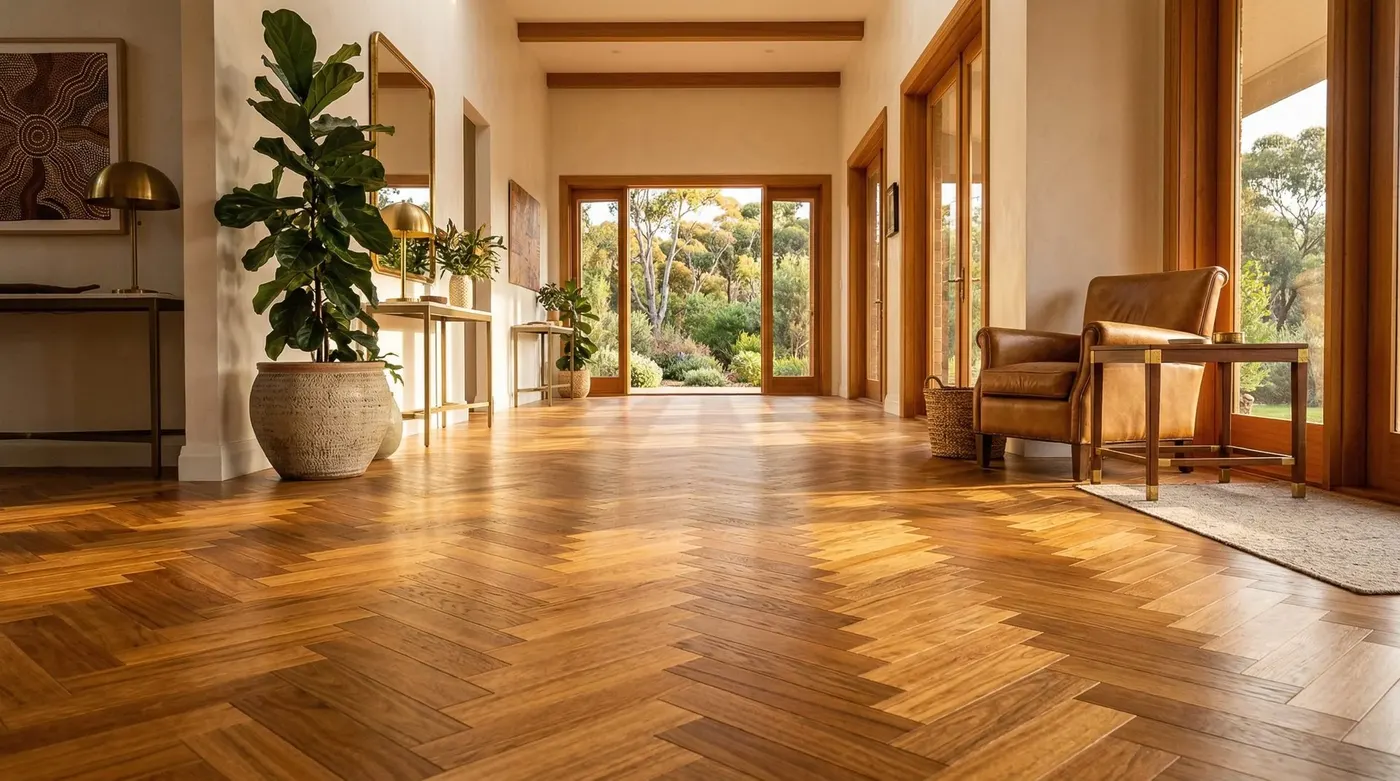
The mid-range of the spectrum encompasses the warm honey, caramel, amber, and golden-brown tones that represent the largest volume of floor sales in the Australian market — and for good reason. These tones possess natural warmth without visual heaviness, and they are sufficiently versatile to sit within a very wide range of interior styles.
Spatial effect: Mid-tone floors neither advance nor recede dramatically. They create a warm, grounded feeling without the visual weight of dark floors. Functionally, they represent the practical sweet spot: they hide dust effectively, do not reveal spills as readily as light floors, and do not show the fine scratches and footprint marks that dark floors magnify.
Interior context: Honey and caramel tones are the classic Australian family home specification — they suit the warm afternoon light characteristic of west-facing rooms, complement Australian hardwood joinery, and age gracefully as the room evolves.
Espresso, Charcoal, and Dark Tones
At the darkest end, espresso brown, deep walnut, and charcoal floors create the most dramatic interior effect in the flooring spectrum.
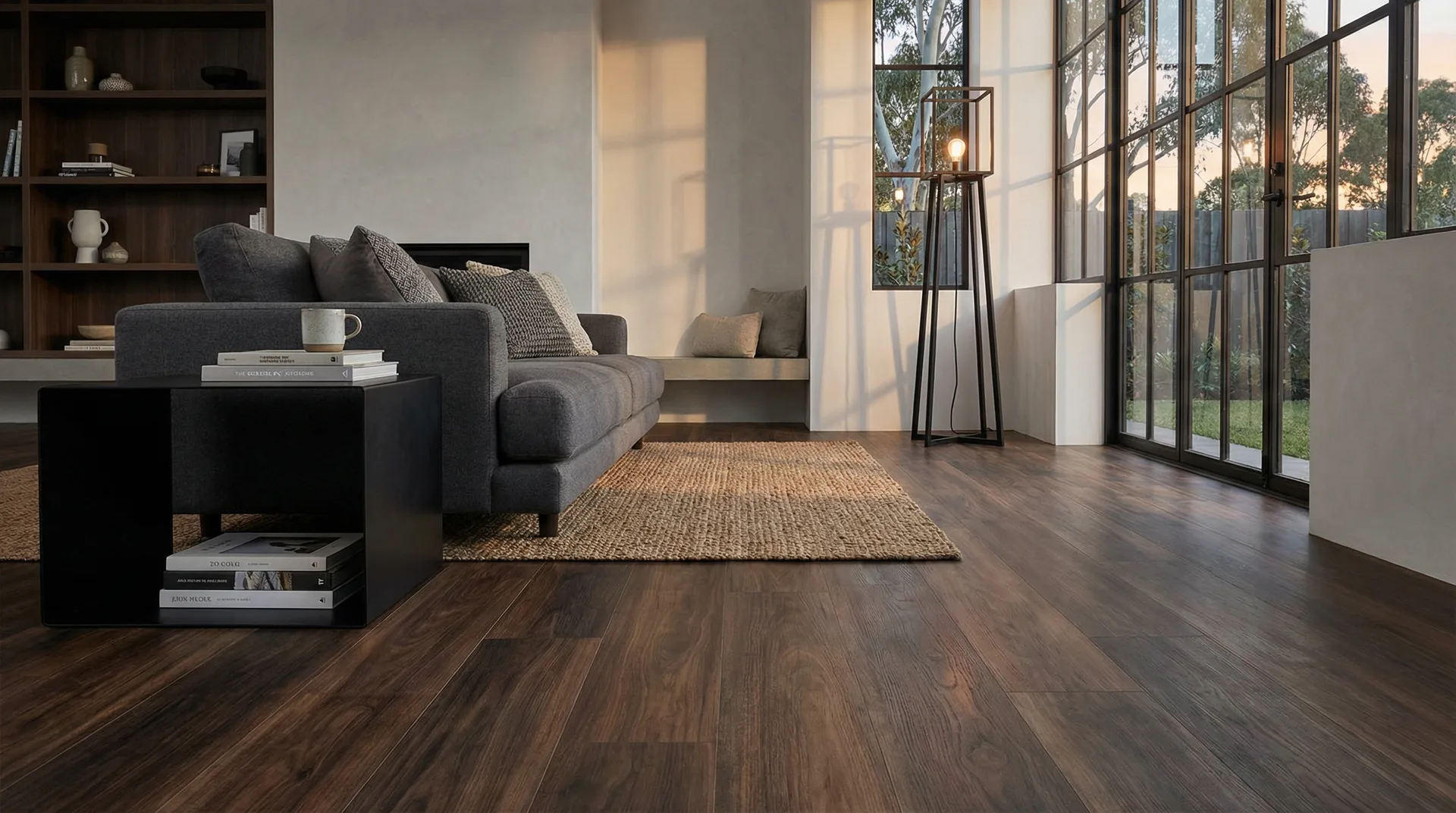
Spatial effect: Dark floors advance visually, grounding the room and creating a sense of contained warmth. When executed well — with pale walls, generous natural light, and considered material layering — a dark floor produces one of the most sophisticated domestic interiors achievable.
What they show: Dark floors are demanding. They reveal dust, fine scratches, pet hair, footprints, and watermarks with a clarity that lighter floors do not. In a high-traffic household, maintaining the visual integrity of a very dark floor requires consistent, diligent care. This is not a reason to avoid them; it is information that should influence the decision.
Interior context: Dark floors work best in rooms with confident natural light, pale walls, and restrained furniture palettes. In naturally dim rooms, dark floors can make the space feel heavy.
How Natural Light Changes Everything
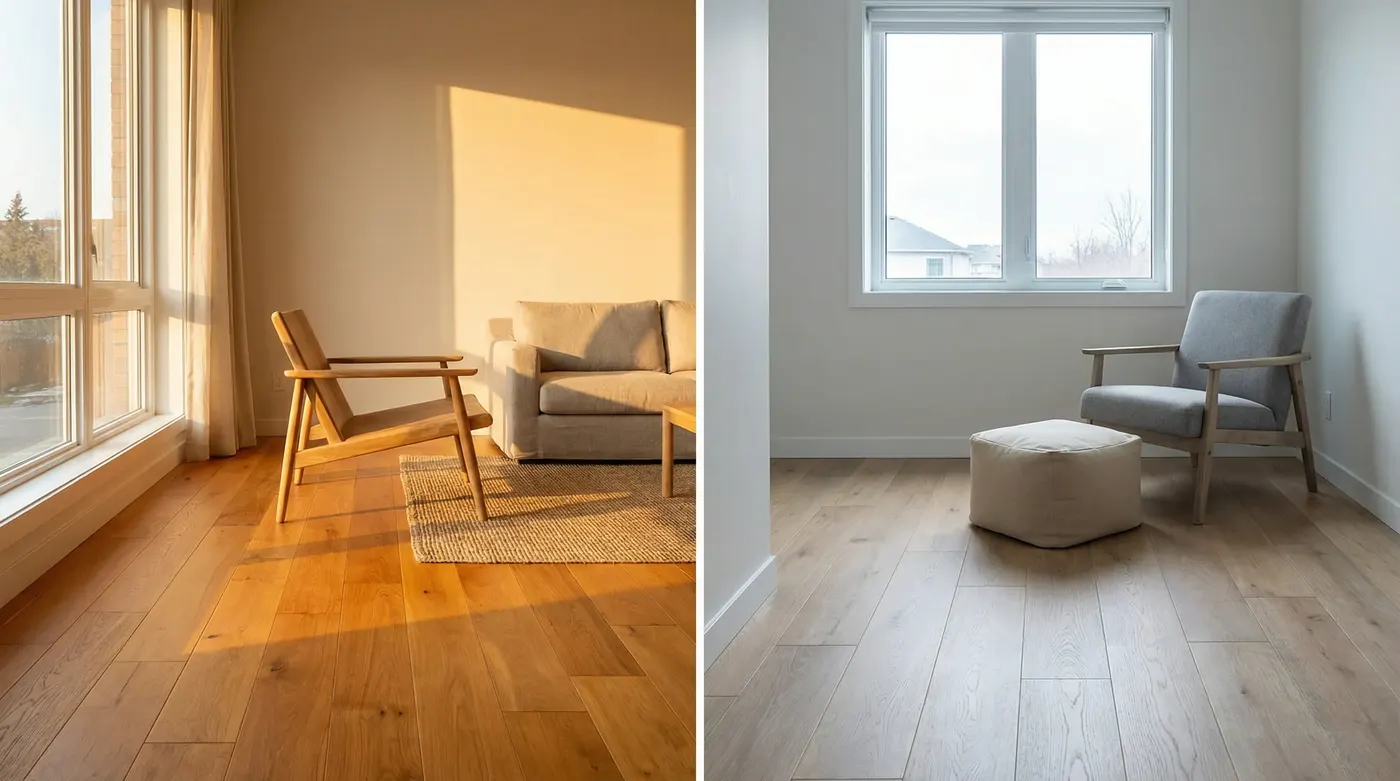
The same floor sample, installed in two rooms with different orientations, will appear as two different products. This is not inconsistency in the material — it is the physics of light.
North-Facing Rooms: Warm Light Compensation
In Australia, north-facing rooms receive direct sunlight through much of the day and are flooded with warm, amber-toned light — particularly in the afternoon. This warm light amplifies the warm undertones in any floor surface: a honey-toned timber reads even warmer and more golden; a warm-beige carpet reads rich and amber.
Design implication: North-facing rooms can support a broader range of floor tones, including cooler-undertone products that benefit from the warming effect of the light. A cool ash grey floor in a north-facing room will often read closer to a warm taupe in practice. Cool-toned floors — ash, grey-wash, taupe — can provide effective visual balance in rooms where warm northern light would otherwise make every surface read amber.
South-Facing Rooms: Cool Light Conditions
South-facing rooms in the Australian context receive no direct sunlight — their light is diffuse, reflected sky light with a distinctly cool, blue-grey quality. In these rooms, cool-undertone floors are amplified further: grey becomes grey-blue; ash becomes cold. Warm-undertone floors — honey oak, amber, caramel — are warmed by association and tend to look their best in cool-light rooms, where they provide welcome warmth without the room appearing over-yellow.
Design implication: In south-facing rooms, be cautious of very cool, grey, or ash-tone floors. They can make a space feel clinical and unwelcoming under cool diffuse light. Warm mid-tones are reliably effective.
East-Facing Rooms: Morning Warmth, Afternoon Cool
East-facing rooms receive warm, pink-toned morning light and cool afternoon light. Floor tones will read differently depending on the time of day at which they are observed — a consideration for sampling correctly (see below).
West-Facing Rooms: Afternoon Intensity
West-facing rooms receive intense, warm afternoon sunlight that can be blinding in summer. Floor tones in these rooms are experienced most often under strong warm light. Pale floors can glare; mid and dark tones manage the afternoon intensity more comfortably.
The Undertone Principle: Identifying Warm vs Cool
Every floor colour — whether timber, carpet, or any other product — carries an undertone that is distinct from its surface appearance. The undertone is the secondary colour visible in the floor’s base hue, and it is the dimension of colour most responsible for whether a floor looks harmonious or discordant with the other fixed elements of a room.
Warm undertones: Yellow, amber, orange, red, brown. A floor with warm undertones will read harmoniously with warm joinery (natural oak, walnut, brass hardware), terracotta, cream, off-white, and earthy paint tones.
Cool undertones: Grey, blue, ash, green, taupe. A floor with cool undertones harmonises with cool-toned joinery (white oak with grey wash, painted cabinetry in blue-grey, chrome and matte black hardware), white walls, and paler, more restrained palettes.
The common mistake: Selecting a “grey” floor for a contemporary kitchen with warm-toned stone benchtops and natural timber veneer cabinetry — and discovering that the grey floor’s cool undertone creates a jarring contrast with every warm element above it. The floor is not wrong in isolation; it is wrong in context.
Testing undertone: View the sample in isolation against a pure white background. Ask: does this floor read yellow, amber, or red against white? Or does it read grey, blue-green, or silver? That first impression is the undertone.
Sampling Correctly: The Method Most People Get Wrong
The single most common cause of floor colour regret is inadequate sampling. Most clients select flooring from a small sample viewed on a showroom table under fluorescent or tungsten lighting, held at standing height, and evaluated for fifteen minutes. This is not sampling — it is a guess.
The correct sampling protocol:
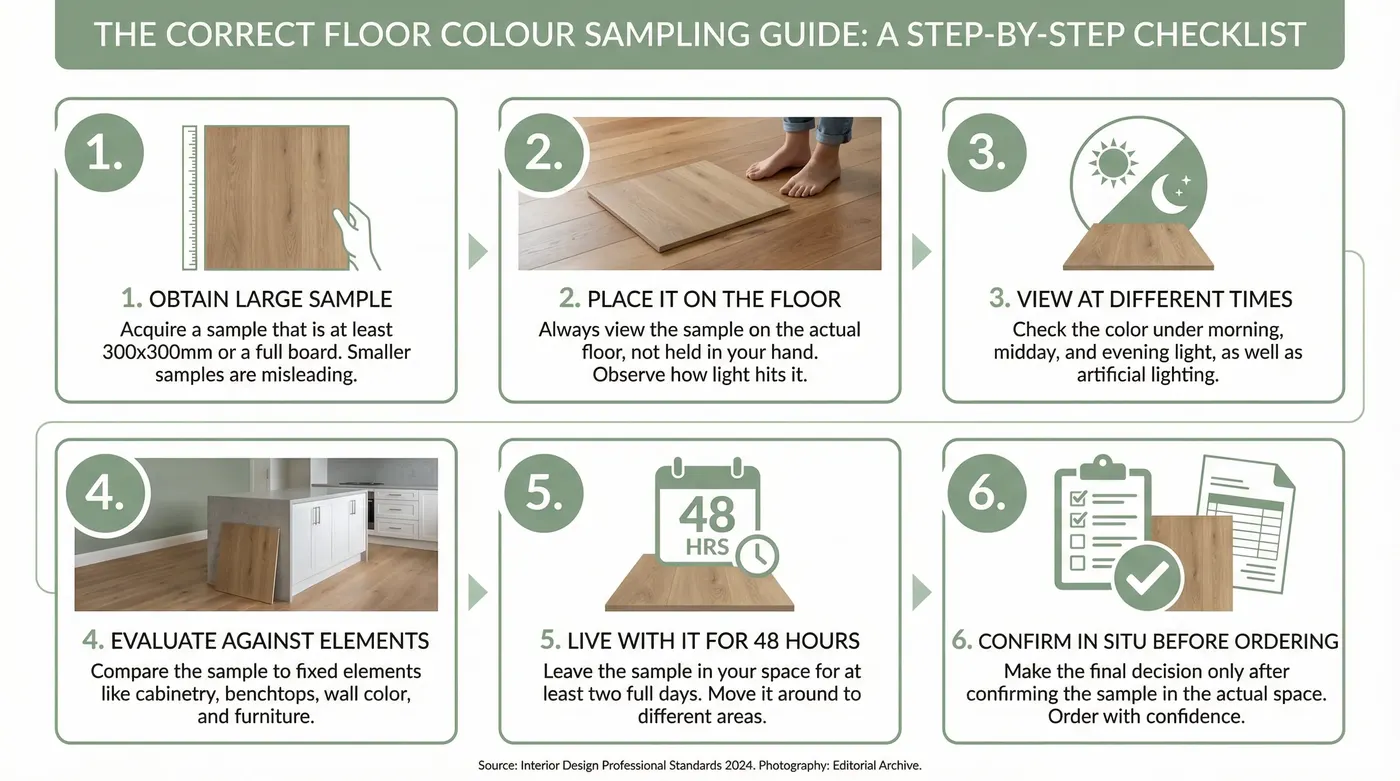
- Obtain a sample that is large enough A 100mm tile or a short board offcut does not communicate how a floor reads across a room.
- Place the sample on the floor. Floor surfaces are viewed horizontally at a low angle, not vertically at eye level. Colour reads differently at floor level under raking light than it does held upright.
- View it at multiple times of day. Morning, midday, and evening artificial light will each reveal a different version of the floor. A tone that looks perfect at noon may read poorly under warm incandescent light in the evening.
- Evaluate it next to fixed elements. Bring the sample as close as possible to the fixed elements it will live alongside: kitchen benchtop material, bathroom tile, staircase timber, any existing joinery or cabinetry that will not be replaced.
- Live with it for 24 hours. Leave the sample on the floor where the floor will be installed. Return to it without expectation. The initial impression matters less than the sustained, unstudied one.
- Evaluate multiple samples simultaneously. Never evaluate a single option in isolation. Seeing two or three candidates beside each other accelerates the decision and clarifies what you are actually comparing.
Coordinating with Fixed Elements
In any renovation or new build, some elements are fixed: kitchen benchtops that will remain, bathroom tiles already selected, a staircase balustrade in a specific timber, an existing fireplace surround. The floor must relate to these elements — it cannot be selected in isolation from them.
Kitchen benchtops: The benchtop material typically has an undertone profile similar to a floor. A Calacatta marble benchtop with warm ivory and gold veining is a warm element; the floor beneath it should carry warm undertones to create cohesion. A cool stone or concrete-look benchtop in charcoal and grey works with cool-undertone flooring. The rule is not matching — it is harmonising in temperature.
Staircase balustrades and joinery: In homes where an existing staircase will remain, the staircase timber is a powerful fixed reference. A natural Tasmanian oak balustrade sets a warm mid-tone benchmark against which the floor will be constantly compared. The floor should either closely match (continuity) or deliberately contrast (tension) — a floor that accidentally falls between matching and contrasting, reading as a near-miss, is the least satisfying outcome.
Bathroom tiles: Where flooring continues into bathroom or wet areas (often the case in open-plan contemporary homes with luxury vinyl throughout), the tile and floor must be evaluated as a continuous palette rather than separate decisions.
Dark Floors: The Full Picture
Dark floors are compelling and, in the right conditions, produce exceptional interiors. They require clear-eyed assessment.
What they require:
- Consistent, diligent cleaning — a quality mop or microfibre flat-mop system, used frequently
- Mindful management of pets (light-coloured pet hair is highly visible on dark floors)
- Either high natural light or confident interior lighting to prevent heaviness
- A cleaning routine that accepts watermarks as an ongoing maintenance item
What they deliver:
- Dramatic visual sophistication
- Excellent grounding of rooms with pale walls
- Exceptional compatibility with dark/jewel-tone paint colours (charcoal, ink, forest green) for rich, layered interiors
- Excellent contrast with pale upholstery, natural linen, and aged brass
The client who should not choose a dark floor: one who is unwilling to commit to the maintenance routine, or who is installing in a household with young children and large dogs in a high-traffic open plan.
Carpet Colour: Additional Considerations
Carpet colour selection operates on the same undertone and orientation principles as timber, but with two additional factors specific to textile surfaces.
How Pile Height and Construction Affect Perceived Colour
Carpet colour in a showroom swatch does not translate directly to carpet colour on the floor of a large room. Two mechanisms alter the perception:
Pile direction: Cut pile carpet — particularly plush pile — reflects light differently depending on the direction in which the pile is lying. Pile leaning toward the light source appears lighter; pile leaning away appears darker. This creates the shading effect characteristic of plush carpets: large areas of a room can appear lighter or darker than the swatch, depending on viewing direction and pile orientation after installation.
Area effect (simultaneous contrast): A small swatch of carpet in the hand reads as a specific colour. The same colour installed across 30 square metres appears more intense and saturated. Muted tones become more assertive; soft mid-tones have more presence than the sample suggests. Always mentally adjust perceived intensity upward when evaluating carpet swatches for large areas.
Current Melbourne Trends in Carpet Colour
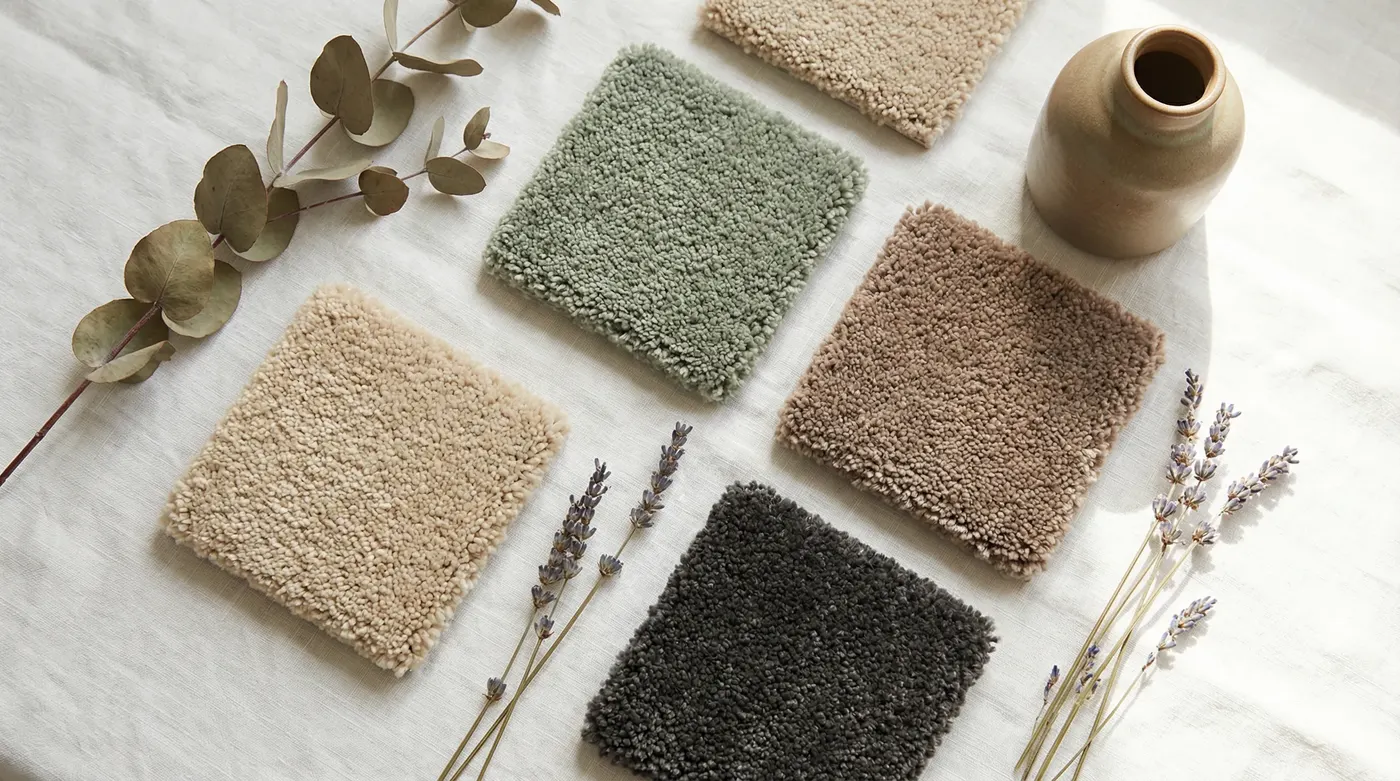
Melbourne’s 2026 carpet palette has shifted decisively away from the cool grey dominance of the previous decade. The current trend direction:
- Warm earthy neutrals: Oatmeal, biscuit, linen, warm stone — tones that reference natural materials and sit comfortably within the biophilic design movement
- Softer warm browns: A significant shift back to brown, but in lighter, dustier variations rather than the chocolate tones of the 2000s
- Muted organic greens: Sage, olive, dried herb — greens at low saturation that read as neutral in situ but carry distinctly natural associations
- Deep, moody tones: Charcoal, slate, and even deep teal for bedrooms and media rooms seeking the cocoon effect
Future-Proofing: Neutrals Over Trends
The most commercially and emotionally durable floor colour decision is one that will look as considered in fifteen years as it does today. This is not an argument against beautiful, characterful interiors — it is an argument for building them on neutral foundations.
The principle: Trendy flooring colours date the room. The floor is the most expensive and least frequently replaced element of the interior. A floor chosen because it was the defining trend in the year of installation will announce that vintage with increasing clarity as the years pass and the trend recedes.
The neutral floor allows the room to evolve. Wall colours, soft furnishings, artwork, and decorative objects can all be changed without touching the floor. A warm mid-tone timber floor or a classic oatmeal wool carpet is a platform onto which successive iterations of the interior can be built, each current and fresh, without the floor becoming the limiting factor.
Neutrals are not boring. The skill is in selecting neutrals with strong character — distinctive grain patterns, interesting texture, complex undertones — that provide visual richness without the short shelf-life of a trend-specific tone.
When a client asks for a guarantee about a floor choice, the answer is almost always found in the warmth, practicality, and enduring quality of a considered neutral — well-matched to the room’s light, sensitive to its fixed elements, and beautiful enough to earn its place for decades.
Colour is felt before it is understood. The right floor colour creates a room that visitors sense as cohesive and comfortable without being able to articulate precisely why. The wrong one creates a persistent, low-level dissonance that no amount of furniture arrangement will resolve. The method above does not eliminate subjectivity — no design framework can. But it ensures that the decisions being made are informed decisions, grounded in the physical reality of the space rather than the conditions of the showroom.
Published by The Flooring Centre — Melbourne's premium carpet and flooring superstores. Visit our Nunawading and Hawthorn showrooms.