By The Flooring Centre Technical Team
The flooring industry has a language problem. Words like waterproof, water-resistant, and moisture-tolerant are used interchangeably in marketing materials, showroom conversations, and product specifications, creating a fog of imprecision that — when it settles on the wrong floor in the wrong room — leads to delaminated boards, swollen substrates, failed adhesive bonds, and flooring warranties that evaporate at precisely the moment you need them.
This article is written with one purpose: to give you technically precise language and practically useful guidance for choosing the correct floor covering for wet and wet-adjacent areas. The bathroom and the laundry are unforgiving environments. Only the right materials, installed in the right way, with the correct waterproofing system beneath them, will perform reliably across the life of the building.
The Best Waterproof Bathroom Flooring at a Glance
For readers who want the practical answer first, here are the four flooring categories that genuinely belong in a bathroom or laundry — in order of how often we specify them:
- Porcelain or ceramic tile — the technical gold standard. Genuinely waterproof at the body, AS 4586-rated for slip resistance, and the only material that satisfies AS 3740 wet-area requirements without qualification. Best for the main bathroom floor and shower floors.
- Sheet vinyl — the most cost-effective genuinely waterproof option. Continuous, seamless, and warm underfoot. Coved up the wall a short distance for the most water-tight result. The right choice for laundries and rental-grade bathrooms.
- Luxury Vinyl Tile (LVT) and waterproof vinyl planks — the most popular boards-format waterproof bathroom flooring. Look like timber or stone, and the rigid-core (SPC) versions tolerate occasional standing water. Suitable for powder rooms and bathrooms that don’t see daily steam, but seams remain a watch-point.
- Large-format stone or stone-look porcelain — the design specification for high-end bathrooms where the floor is part of the architecture rather than a finish.
What is not waterproof bathroom flooring — despite what marketing language suggests — is any timber-based product. Engineered hardwood, laminate, hybrid and bamboo all fail in wet areas. We explain why below, and then walk through the correct materials and the standards they need to meet.
The Myth of Waterproof Timber-Based Flooring
Let us begin by dispensing with one of the most persistent misconceptions in the residential flooring market.
No timber-based product is waterproof. Not engineered hardwood. Not laminate. Not bamboo. None of them.
This statement is worth sitting with, because marketing language has trained consumers to believe otherwise. Products are described as having “waterproof cores,” “sealed click-lock joints,” and “moisture-resistant surfaces” — and these claims may well be accurate within their specific technical scope. But accurate technical claims about individual components do not add up to a waterproof product system.
Here is what actually happens when a timber-based floor encounters a genuinely wet environment:
Engineered Hardwood
Engineered hardwood is constructed with a timber veneer face layer over a cross-laminated core — in quality products, typically Hevea Brasiliensis or a comparable stable hardwood. The dimensional stability of this construction is genuinely superior to solid timber, and the sealed UV-lacquer on the face layer provides meaningful resistance to incidental surface moisture. In a kitchen, a dining room, or a busy living area subject to occasional spills, a high-quality engineered hardwood floor performs well.
In a bathroom or laundry — where standing water is routine, where steam is a constant in shower zones, where the floor is actively wet for extended periods — engineered hardwood will fail. Water penetrates the click-lock or tongue-and-groove joints between boards regardless of how tightly they are manufactured. Once beneath the boards, moisture attacks the adhesive, the core layers, and ultimately the subfloor. The result — boards that cup, delaminate, or separate — may take months to become visible, but it is inevitable.
Laminate Flooring
Even water-resistant laminate can struggle in these environments. The HDF (high-density fibreboard) core that gives laminate its rigid character is hygroscopic — even the water-resistant versions and it absorbs moisture after a certain time frame of exposure, swelling and distorting in ways that are neither reversible nor repairable. A flooded bathroom with laminate flooring is an expensive problem. Even routine steam and splash exposure in a bathroom will cause progressive swelling at the board edges over 12 to 18 months.
It bears stating plainly: engineered hardwood and water resistant laminate flooring should never be installed in a bathroom or laundry. This is not merely our recommendation — it is inconsistent with AS 3740 (the Australian Standard for waterproofing of domestic wet areas), which establishes a clear framework for what is required beneath any floor covering in a wet area.
What the Standards Actually Require
AS 3740 — Waterproofing of Domestic Wet Areas
AS 3740 (Waterproofing of Domestic Wet Areas) is the Australian Standard that governs how wet areas — including bathrooms, showers, ensuites, laundries, and sanitary compartments — must be constructed to prevent water damage to the building fabric. It is a mandatory reference in residential construction and renovation, and any flooring installation in a wet area that does not comply with its requirements creates structural liability.
AS 3740 establishes a hierarchy of wet area categories:
- Zone 1: Shower recesses (highest risk — continuous water exposure during use)
- Zone 2: Bathroom floor surrounding the shower (routine splash and standing water)
- Zone 3: Adjacent areas including ensuites and laundries (intermittent moisture exposure)
For Zone 1 and Zone 2, AS 3740 requires an impermeable waterproofing membrane applied to the substrate before any floor covering is installed. This membrane — whether liquid-applied, sheet-membrane, or cementitious — must extend a minimum of 100mm up the walls at floor junctions, and to the full height of the shower recess walls. The floor covering sits on top of the membrane, not as a substitute for it.
The critical implication: even a tile floor — the most durable and moisture-tolerant of all wet-area floor coverings — requires correct waterproofing beneath it. The tile and grout do not constitute the waterproofing system; the membrane does. This distinction matters enormously when selecting both the floor covering and the tradesperson who will install it.
AS 4586 — Slip Resistance Classification
Wet floors are dangerous floors. The Australian Standard AS 4586 (Slip Resistance Classification of New Pedestrian Surface Materials) provides the framework for understanding and specifying anti-slip performance in flooring products.
For bathroom and laundry floors — which are wet during use and frequently wet between uses — the minimum requirement is:
- P3 classification (pendulum wet test) for areas subject to regular wet exposure, including bathroom floors, shower surrounds, and laundry floors
- R10 classification (ramp test) as an alternative measure — R10 represents the minimum acceptable slip resistance for a wet area floor in a residential application
P3/R10 is a minimum, not a target. In households with elderly occupants, young children, or any resident with a balance or mobility consideration, P4 or R11 should be considered the appropriate standard. Falls in bathrooms are among the most common causes of domestic injury in Australia; the difference between a P3 and a P4 floor is meaningful in a risk context.
What Actually Works: The Right Materials for Wet Areas
Ceramic and Porcelain Tile: The Technical Standard
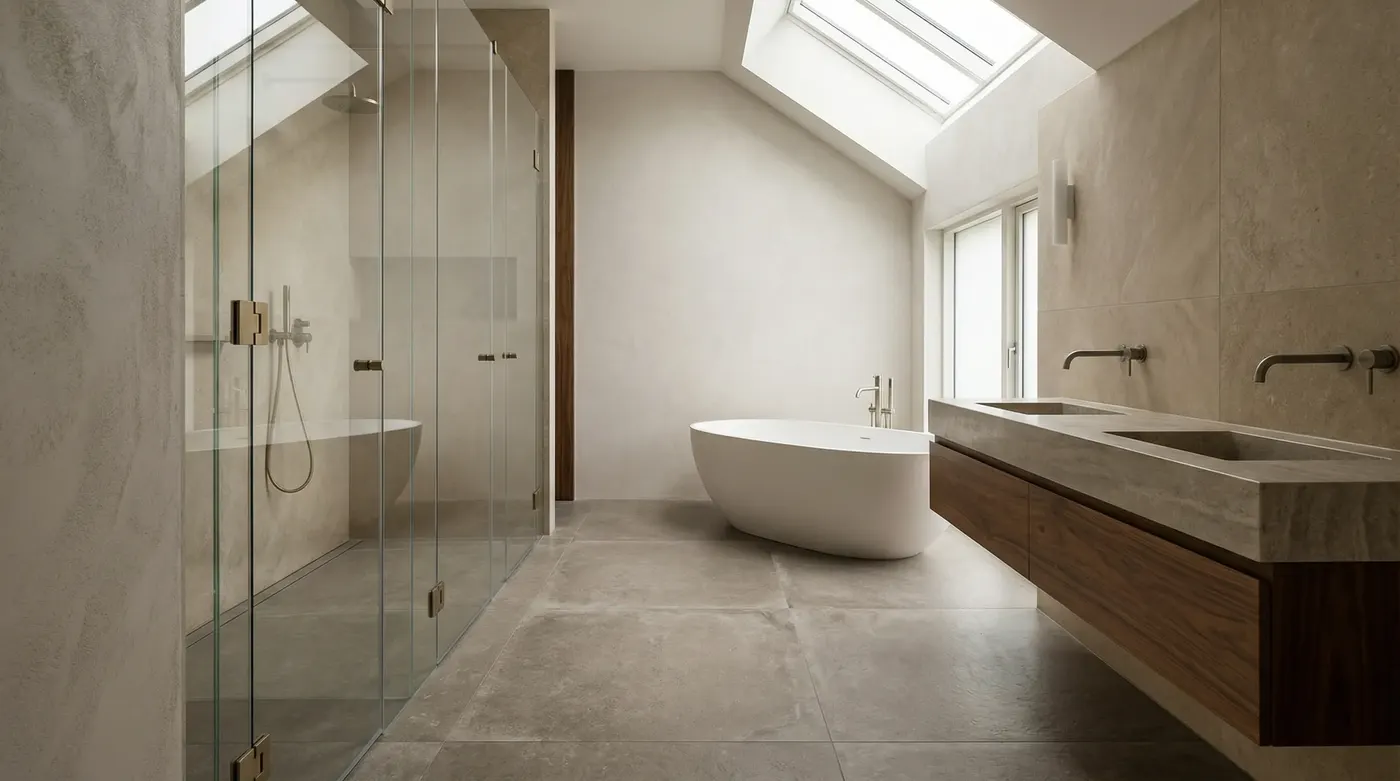
Fired ceramic and porcelain tile remains the definitive wet-area floor covering solution, and for good reason. Vitreous porcelain — the category that includes most premium bathroom tiles — is impermeable to water by construction: its kiln-fired, glassy structure has a water absorption rate below 0.5% (classified as Group Ia under ISO 10545-3), meaning liquid cannot penetrate the tile body itself.
Properly installed over a compliant AS 3740 waterproofing membrane, with cement-based grout applied at the correct joint width, a porcelain tile floor in a bathroom will last indefinitely. It is the only floor covering that genuinely fulfils the technical requirements of a wet area without any qualifying caveats.
The design range available in porcelain — from large-format 600mm × 1200mm slabs that read as single continuous planes through to mosaic formats, from matte stone-looks through to polished marble aesthetics — has expanded dramatically in the past decade. The compromise between technical performance and design intent that once defined wet-area flooring has largely disappeared. You can have a bathroom floor that looks like Calacatta marble, and performs like an airport concourse. Those are not incompatible objectives.
Vinyl Sheet: Seamless and Practical
Vinyl sheet flooring is the workhorse solution for laundry and utility wet areas. Its defining advantage is that it is laid as a single continuous piece with no joints — the pathway through which water invariably finds its way to the subfloor is eliminated at source. When correctly heat-welded at seams (where seams are unavoidable in large areas) and coved up the walls to a minimum height of 100mm, vinyl sheet creates a virtually impermeable floor-and-wall junction system.
Modern heterogeneous vinyl sheet products are vastly more visually sophisticated than earlier generations — textured stone and timber looks are standard in the current product range — and their cost-effectiveness for laundry and utility bathroom applications is difficult to match. For commercial wet areas such as amenity blocks, change rooms, and institutional bathrooms, vinyl sheet in appropriate thicknesses (minimum 2.0mm total construction) remains the technically preferred specification.
Luxury Vinyl Tile (LVT) and Planks
Luxury vinyl tile and plank products offer genuine water resistance at the individual tile/plank level. However, LVT and LVP products are installed as an assembled floating or glued floor system with joints between individual tiles or planks. Those joints are not waterproof — they are tight, and in a quality product they may be sealed with a factory-applied surface coating that resists casual moisture, but they are not hermetically sealed. Water that enters a joint — whether from mopping, from standing water, or from steam condensation — can accumulate beneath the installed floor.
In a standard bathroom, this typically presents as: moisture under the floor, potential for mould and odour in the subfloor cavity, and ultimately floor failure driven not by failure of the LVT itself but by failure of the substrate.
The technically accurate position on LVT in wet areas: it is not the first choice for Zone 1 or Zone 2 wet areas, and should not be specified where standing water is routine. As a transitional material for bathroom-adjacent spaces, it can be appropriate with correct detailing.
The Critical Detail: Threshold Treatment
The transition between a wet area (tiled) and an adjacent dry area is the most technically vulnerable point in any mixed-material bathroom specification. Water follows the fall of the floor and will track from the wet zone to the dry zone unless physically arrested.
A correctly detailed threshold treatment uses:
- A solid aluminium or stainless steel transition strip with a raised central ridge that breaks the water’s travel path
- Silicone sealant on both sides of the transition strip, applied to a clean, primed substrate
- A floor fall in the wet area directed toward the drain, not toward the transition — this is a waterproofing issue that should be addressed in the rough-in stage, not by the flooring installer
Subfloor Requirements: Falls, Drainage, and Moisture Management
The AS 3740 framework does not begin with the floor covering — it begins with the subfloor. The decisions made at subfloor level determine the success or failure of every subsequent layer.
Floor Falls
Wet area floors must fall to a floor waste (drain) at a minimum gradient of 1:60 — meaning the floor drops 1mm for every 60mm of horizontal run. A shower recess floor should fall at 1:40 or steeper in the immediate drain vicinity. Falls that are shallower than the minimum allow water to pond, which accelerates the work that water does on any vulnerabilities in the floor system — grout cracks, membrane pinholes, joint gaps.
Falls must be established in the substrate (the screed or concrete slab) before the waterproofing membrane is applied. They cannot be corrected at the tile-laying stage without compromising either the membrane or the tile installation.
Subfloor Moisture Content
Before any floor covering — including tile over membrane — is installed in a wet area, the concrete or sheet subfloor must be assessed for residual moisture using a calibrated moisture meter, consistent with the protocols in AS/NZS 1080.1 (Timber — Methods of Test, Moisture Content). Where new concrete is involved, a minimum 28-day cure is standard, but moisture readings should be taken regardless of cure time — new concrete in enclosed spaces can retain elevated moisture content well beyond the 28-day nominal cure period.
For hybrid vinyl installations in bathroom-adjacent spaces, the subfloor moisture emission rate should not exceed the hybrid product manufacturer’s specified maximum — typically 75% relative humidity as measured by the in-situ hygrometer test method.
Maintenance in Wet Environments
The long-term performance of any wet-area floor covering depends as much on maintenance practice as on the initial specification.
Tile Grout: The Vulnerability to Monitor
Grout is the most vulnerable element of a tiled wet-area floor. Over time, grout can crack (through substrate movement), erode (through cleaning chemical exposure), and develop biological growth (mould and mildew in porous, unsealed grout). Annual inspection and resealing of grout joints using a penetrating silicone-based grout sealer is the minimum maintenance standard for a tiled wet area.
Where grout cracking is observed, prompt repointing is essential — cracked grout provides a direct water pathway to the waterproofing membrane beneath, and any membrane damage compromised by infiltrated water may void the waterproofing warranty.
The Design Solution: Continuity Without Compromise
The most common design request we receive in the context of bathroom flooring is this: “We want to run the same floor as the rest of the house into the ensuite. Can we do that?”
The technically honest answer is: partially, and with the right strategy.
The correct approach is a hybrid solution:
- Run the continuous flooring material — whether engineered timber, laminate, hybrid, or premium LVP — to the threshold of the wet area
- Install a clean, well-detailed transition at the threshold (aluminium T-bar in a matching finish)
- Use a complementary tile — not a matching tile, but one that is tonally referenced to the main floor — for the wet-area floor itself
- Where the space allows, configure the shower as a fully enclosed wet zone with its own tile floor and drainage fall, keeping the majority of the ensuite floor in the dry zone
- Consider large-format porcelain in a warm tone matched to the main floor timber — a 600mm × 1200mm stone-look porcelain in a similar tonal palette to a European Oak floor is a design solution that reads as intentional and cohesive rather than as a forced compromise
This is not a technical concession — it is a design opportunity. The threshold between the timber or hybrid floor and the tile wet area is a natural detail line that, when handled well with the right transition strip and tonal pairing, becomes an architectural moment rather than a problem to be hidden.
The wet areas of a home are the rooms where the consequences of a poor flooring decision are the most expensive, the most structurally damaging, and the most difficult to reverse. They are also among the rooms where design quality matters most — a bathroom that looks beautiful and performs correctly for twenty years is not merely satisfying, it is genuinely impressive. Those outcomes are not in tension with one another. With the right material selection and correct installation practice, they are entirely achievable.
Frequently Asked Questions
What bathroom flooring is actually waterproof?
Ceramic and porcelain tile, vinyl sheet, and luxury vinyl tile (LVT) or planks are the categories that genuinely belong in a bathroom or laundry. Tile is the technical standard we specify most often.
Is hybrid, laminate or engineered timber waterproof for bathrooms?
No. Despite marketing language, engineered hardwood and laminate fail in wet areas because they are timber-based. Hybrid and bamboo are also the wrong products for bathrooms — hybrid is water-resistant for everyday spills, not waterproof for wet areas.
What Australian standards apply to bathroom flooring?
AS 3740 covers waterproofing of domestic wet areas. AS 4586 covers slip resistance classification. The floor covering sits on top of a correctly waterproofed system — it is not a substitute for that system.
What is the most common bathroom flooring failure?
Threshold treatment and subfloor falls. Even the right material fails if water can travel under the floor at the doorway, or if the subfloor does not fall correctly to the waste.
Published by The Flooring Centre — Melbourne's premium carpet and flooring superstores. Visit our Nunawading and Hawthorn showrooms.